


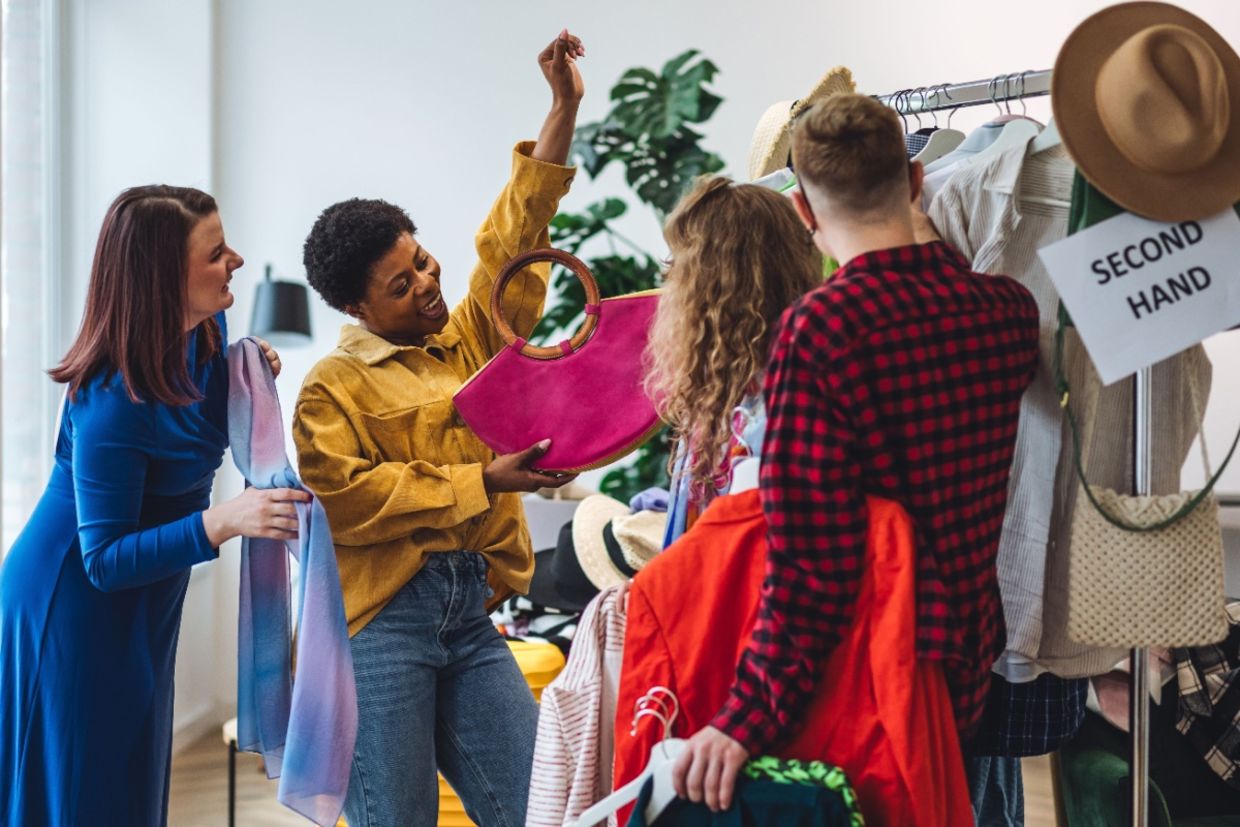
(Vera Prokhorova / Shutterstock.com)
You can borrow more than books at this library.
Come visit your local library and walk out with a new mystery book, a fantasy novel, or a fresh, fashionable wardrobe. While that may seem like the stuff of science fiction, in some libraries this novel idea is already a reality.
COSH! reported that clothing libraries where patrons can check out outfits, instead of books. These garments swaps are located online, in boutiques, and some are even located inside traditional book libraries. How do these livery lending libraries work?
Why use a Clothing Library?
Fast fashion has enabled people to find their style and express themselves quickly and inexpensively. But, it does come at a cost. The fashion industry contributes to millions of tons of waste per year. Annually, about 175 million tons of textiles are produced, but only 6.6 million tonnes are consumed. Some of the spare 169 million tonnes ends up in landfills.
There is an antidote to wardrobe waste. Reusing clothing items can significantly reduce one’s carbon footprint and a system that allows used clothing to easily be reworn, borrowed, or rented can slice that article’s carbon emissions nearly in half.
Clothing libraries are institutions that allow for recycling, reusing, and upcycling new garments and these organizations are gaining in popularity. Many existing clothing libraries focus their efforts on luxury or special occasion garments, but the concept is trickling down into everyday wear as well.
Where are These Libraries Located?
Although many clothing libraries are found online or in boutiques, Lizzie Dibble had the idea of lending clothing within the walls of a local library, alongside picture books and novels, Positive News reported.
Dibble started the With Love From… group in 2023 to encourage clothing swaps. Her small organization rapidly expanded into a series of clothing lending programs, including one found within the traditional book library in Oswestry, Shropshire.
She saw the collaboration of clothing recycling and public libraries as an opportunity to both encourage secondhand fashion and to motivate people to visit their local library. She also finds that they are comfortable and non-intimidating places to try out new styles.
“There’s something about the library,” Dibble told Positive.News. “It’s not an intimidating boutique or the busy, noisy high street. I’ve had people tell me that sometimes they’ll go into a shop and even the music makes them feel like they don’t fit in there. We want this to feel welcoming and accessible to everybody.”
Siobhan Shaw, the operations and development manager at Oswestry Library, told the Oswestry & Border Counties Advertizer that, “Public libraries are fundamental to the sharing economy and as such are committed to both protecting the planet and supporting their clientele to borrow more and spend less, while working with communities to minimise financial barriers to the information, equipment, and resources they require.
“This is achieved by exciting collaborations like this one, and by supporting communities to connect and share what they have with others, whether it is their skills, their knowledge, their art, or even their unwanted clothes.
How to Borrow an Article of Clothing
The BBC reported that the Oswestry clothing lending library worked just like Oswestry’s book lending library. Many clothing swaps require visitors to donate clothing in order to earn “points” that they can “spend” on borrowing items, but at Oswestry’s library within a library, patrons only needed their library cards. With their ordinary cards, they could scan out any book or any article of clothing for three weeks, plus renew checked out items, both linen and paperback.
Each garment is tagged with a scannable barcode that also lists the name of the donor, according to Positive News. Including the names make the clothing seem more special and interesting. Dibble said, “It adds to the idea that preloved clothing is more special, because it has that history.”
The Oswestry experiment is the perfect blend of fashion and literature. It demonstrates that a visit to the library can refresh not just the mind and the wallet, but also the wardrobe. The idea offered benefits to the local library, the community, and even to the organizers themselves.
Dibble told Positive News that she enjoyed watching patrons find recycled items at their local library. “When you see someone pick up something you used to own and say: ‘I love this!’, I get goosebumps. It’s a really nice feeling,” she explained.
YOU MIGHT ALSO LIKE:
Clothing Exchanges are Becoming More Popular
You Can Take Out More Than Just Books at This Library
Why Millennials and Gen Z Are Wearing Their Hearts on Their Sleeves