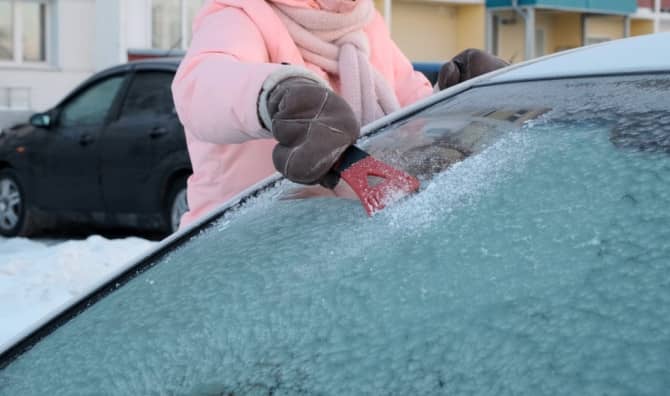
Defrosting Car Windshields Without Using Heat or Chemicals
Winter is a beautiful time. The air is crisp, the snow covers the ground like a sparkly quilt, and indoors everything is warm and cozy.
What is not lovely this time of year is frost. Frost can be a true annoyance and impediment during the cold winter months, especially for people who spend their mornings deicing their windshields before a long commute to work. Now, researchers from the University have published a study presenting their innovative way of getting rid of frost using neither heat nor chemicals.
Ice Lattices
In order to understand the method used by the Virginia Tech researchers to defrost frost, one must first understand a few things about the physical properties of the substances, Virginia Tech News reports. As water freezes, and frost crystals grow, they begin to form a nice and tidy lattice of ice. Except, in reality, the lattice is not as tidy as one might think.
Sometimes, water molecules go a little off base. Maybe a hydrogen molecule goes missing, or an oxygen molecule gets added. These are called ionic defects, and they represent a place in the frost where there is either a positive or negative electrical charge.
So how does this relate to defrosting? The researchers hypothesized that when a high voltage positive charge was placed above the frost, the negative ionic defects would become attracted and start moving toward them, causing the frost crystals to break off and jump up to the electrode. And, as it turns out, they were almost right.
Counterintuitive
According to Interesting Engineering, applying a 120 volt charge resulted in 40 percent of the frost being removed, while 550 volts removed 50 percent of the frost. And yet, when the researchers turned the voltage up even higher, the percentage of frost removed went down, which seems quite counterintuitive.
What was happening was something called charge leakage. At higher voltages some of the electrical charges were leaking into the copper substrate underneath them instead of being applied to the plate with the frost. It was this that was causing the percentage of frost removed to drop.
In order to prevent this, the researchers created a super-insulated, superhydrophobic surface. When using this surface in addition to a high voltage, frost removal was up to 75 percent, and a new era in deicing began.
As lead researcher and assistant professor of mechanical engineering at Virginia Tech, Dr. Jonathan Boreyko told Virginia Tech News, “We hope that in the near future, EDF [electrostatic deicing] will prove to be a cost-effective, chemical-free, and low-energy approach to deicing.”
Though it may seem like a small problem, frost can actually be a large headache, not only for car owners, but for air travel, heat pumps, and other important equipment. Using heating and chemicals to defrost ice is time consuming, expensive, and can be unhealthy for both people and the environment. But by understanding the physics of frost, the researchers from Virginia Tech have found a way to solve this winter snaggle.