Outer Space Welcomes Its First Tourist in a Wheelchair
Advocates work tirelessly to improve accessibility for individuals. These everyday heroes are on a powerful mission. They’re determined to ensure that those with disabilities can lead independent and happy lives.
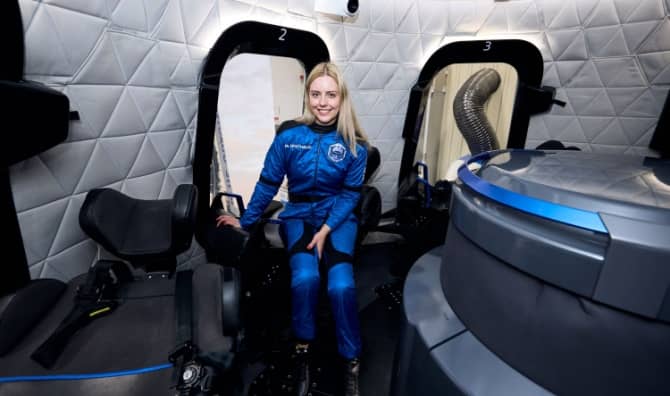
However, entrepreneurs are also devoting their time to helping people with disabilities reach far above the surface of the planet. In a record-breaking first, German engineer Michaela Benthaus became the first wheelchair user to travel to outer space, DW reports. She’s now inspiring others to follow their dreams.
Blasting off While Breaking Barriers
Benthaus launched into outer space while on board the New Shepard NS-37. The spacecraft was piloted by Blue Origin, Jeff Bezos’s space tourism company.
Bezos founded the company in the year 2000 with the goal of allowing people who don’t fit the typical astronaut mold the opportunity to tour beyond Earth’s atmosphere, according to CNN. However, Benthaus still wondered if her paraplegia would prove too much of a challenge. “I always wanted to go to space, but I never really considered it something which I could actually do,” Benthaus explained to CNN.
Weightless in a Wheelchair
Before her maiden voyage, Benthaus prepared to address her physical limitations in microgravity. She also rode alongside former SpaceX executive and friend, Hans Koenigsmann, who received training before the flight on how to assist Benthaus if needed.
The journey, which took around ten minutes, rocketed Koenigsmann, Benthaus, and four other passengers above Earth’s surface. They traveled at more than three times the speed of sound. At the peak of the flight path, passengers experienced a brief period of weightlessness.
Benthaus prepared a strap for her legs beforehand to keep her legs bound so she could leave her seat and peer at the Earth from outside the window. She later said that the strap worked well and that she had a great experience overall. “I did really love the view and the microgravity phase, but I also loved all the going up,” she shared.
Improving Access for Wheelchair Users
Benthaus began using a wheelchair after a 2018 mountain biking accident left her with spinal cord injuries. Her space journey was part of a campaign to raise money for the nonprofit Wings of Life that researches spinal cord injuries.
Her injury, seven years ago, made her more aware of the challenges faced by people with disabilities, according to DW. “After my accident… I really, really figured out how inaccessible our world still is,” she said.
Still, her disability didn’t affect her ability to enjoy her flight into outer space. She described it as “the coolest experience ever,” adding that people should not give up on their dreams, even if the odds feel slim.
Benthaus’s flight points to a future in which access to space is slowly expanding, creating more inclusivity on Earth and beyond. As technology adapts, experiences once considered out of reach are becoming possible.