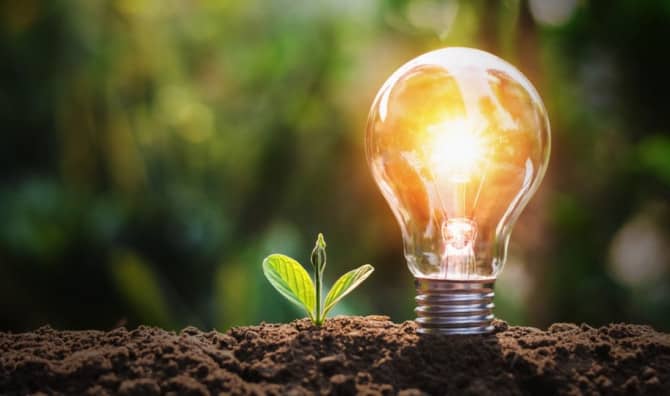
This New Lamp is Powered by Dirt
Though it may not seem like it, dirt is alive. Even if they can’t be seen by the naked eye, soil is full of microbes, fungi, and insects, all breaking down organic matter into nutrients.
Where there is life, there is energy — and now that energy is being converted into electricity, and into light, reported Fast Company. This type of environmentally friendly energy could be key to finding new, sustainable ways to power the world.
Earth Batteries and Microbial Fuel Cells
The idea of harnessing the electricity in soil is not a new idea, according to Best Inventions. In the 19th century, Alexander Bain invented the Earth battery, which worked by placing two electrodes in the ground. This soon led to the soil lamp. The soil lamp works via electrochemical interaction between electrodes and the soil. Two electrodes of different types (copper and zinc) are placed in soil, which creates an electric current which can power low-powered electrical devices such as LED lights.
Now, a new generation of soil-power has arisen with the arrival of the microbial fuel cell. Instead of using the electronic electrochemical properties of soil, the MFC uses the metabolic activity of microorganic organisms in the soil as a source of energy. As bacteria feed on organic matter in soil, they release electrons. Electrodes placed in the soil then capture these electrons creating a stream of electricity which can be harnessed to power small electrical devices.
From Agricultural Monitoring to Emergency Lighting
Though it is still in its inception, and cannot currently be scaled up or used in applications that require a large amount of power, soil power still has practical uses. It could be used in rural areas to do things such as charge phones, or power environmental sensors. It could also be used in emergency situations when infrastructure has been damaged, powering lighting and communication devices. Soil based electricity could also be used in agriculture, powering sensors that could track soil health, crop conditions, or water levels.
As if to prove that soil MFCs could be a sustainable and practical source of power, according to Fast Company, Milú Brunell, a graduate of the Savannah College of Art and Design, recently debuted a beautiful outdoor lamp called the Soli Lamp that is exclusively powered by an MFC. The soil used in the Soli Lamp came from Brunell’s own backyard.
Brunell hopes that one day this technology will power park lighting or streetlights, and is the beginning of the answer to the question she has asked herself: “Instead of just exploiting Earth, how can we collaborate with it, respect it, and coexist with it?”
Brunel’s beautiful lamp and the very existence of MFCs and soil lamps prove that sources of clean, renewable, and sustainable energy can sometimes be right under your feet.