


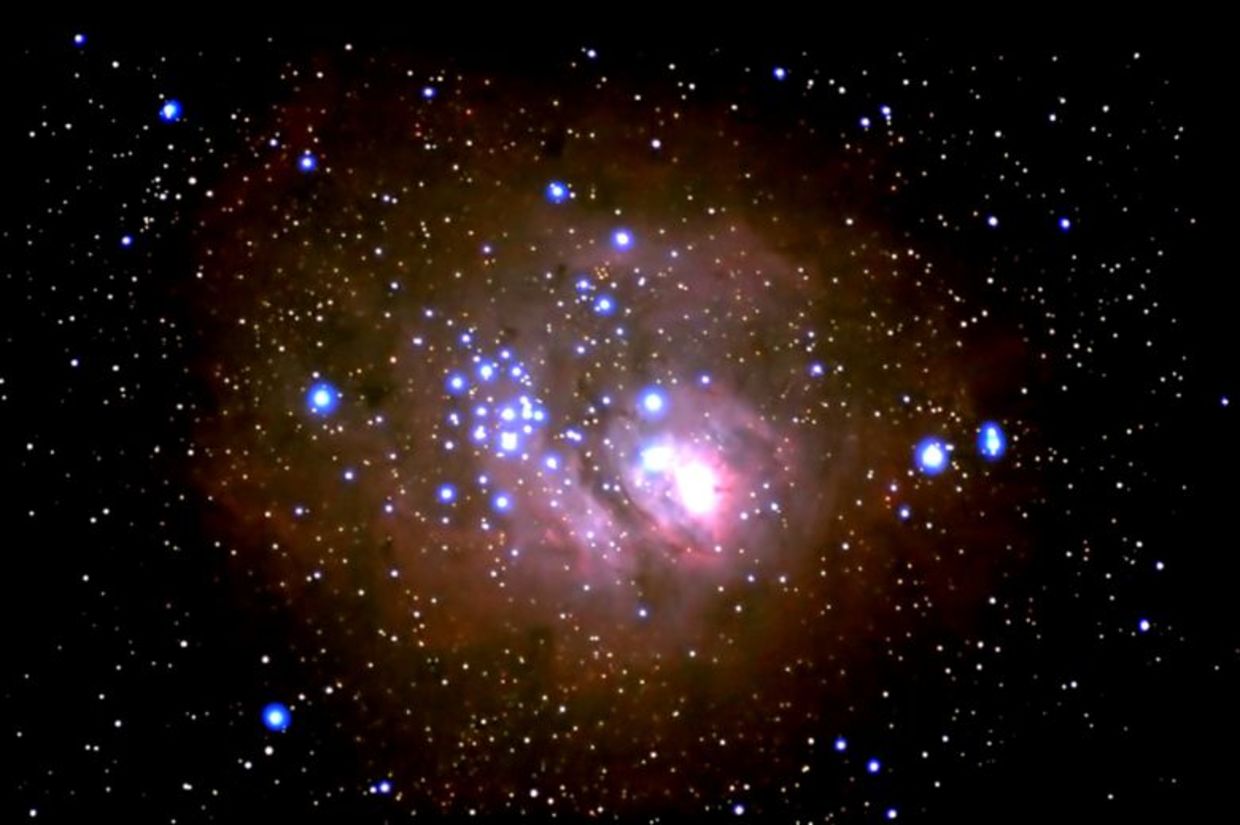
(McCarthy’s PhotoWorks / Shutterstock.com)
Breakthrough new research from an international team led by Faculty of Physics scientists from the country’s prestigious science and technology research university, The Technion – Israel Institute of Technology, details the achievement of an exciting first.
Showcased in Nature Astronomy, this is the debut measurement of cosmic rays inside a faraway star-forming nebula in space, as The Times of Israel reports.
View this post on Instagram
What Are Nebulae?
Nebulae, as NASA Science explains, can emerge from the explosion of a dying star, such as a supernova, or be regions where new stars start to form, as in this case, earning them the moniker of “star nurseries.”
The dust and gases that make up nebulae, mostly hydrogen and helium are dispersed, but gravity can gradually start to pull together clusters of dust and gas. As these clumps grow, their gravity grows accordingly until the clump collapses from its own gravity. This collapse causes the material at the center of the cloud to become very hot, with this hot core being the start of a new star.
A Space-Age Discovery
Astrophysicists need exceptionally powerful telescopes to create images of very distant nebulae, but this Israeli team used NASA’s James Webb Space Telescope (JWST) to go one step further, capturing the invisible cosmic rays located at the core of the galactic nebula Barnard 68, which is 400 light years from Earth, as a Technion Blog details.
Under the leadership of Professor Shmuel Bialy, the team used observations from NASA’s James Webb Space Telescope to measure infrared radiation from cosmic rays that had penetrated the giant, cold and dense nebula Barnard 68, in the faraway Ophiuchus constellation.
Their results have been published in Nature Astronomy and a companion study with Johns Hopkins in the Astrophysical Journal.
How the Team’s Findings Could Shape Future Research
The stars may align for the researchers, as the peer-reviewed study could help reveal more on how stars are born in the galaxy. In fact, NASA has already approved additional JWST time to expand this cosmic-ray mapping across the Milky Way.
“These cosmic rays are crucial for our understanding of the process of formation of new stars,” lead researcher Prof. Shmuel Bialy of the Technion-Israel Institute of Technology’s Physics Faculty told The Times of Israel. He believes that the research results open the door to a new field of study in modern astrophysics.
The findings provide "unequivocal evidence" of cosmic rays', and open a new window in astrophysics for studying star formation, according to co-author David Neufeld of Johns Hopkins University.
Or as Amit Chemke, a master’s student in Bialy’s group, and co-author of the research paper explains: “It is important to people on Earth because we’re researching how stars are formed… . Our Sun was formed billions of years ago, but how are other suns forming?”
Chemke clarifies to The Times of Israel that the term “cosmic rays” can be bewildering. This is because the rays are not radiation, or connected to light. Rather, they are high-energy particles of matter: protons, electrons and atomic nuclei. He shares that they are interested in how cosmic rays influence galactic evolution.
YOU MIGHT ALSO LIKE:
Meet the Visionary African Creator of Friendship Benches
Israel’s ‘Peptide Detective’ Makes Top 10 Scientists’ Ranking
Australia Bans Children Under 16 From Social Media