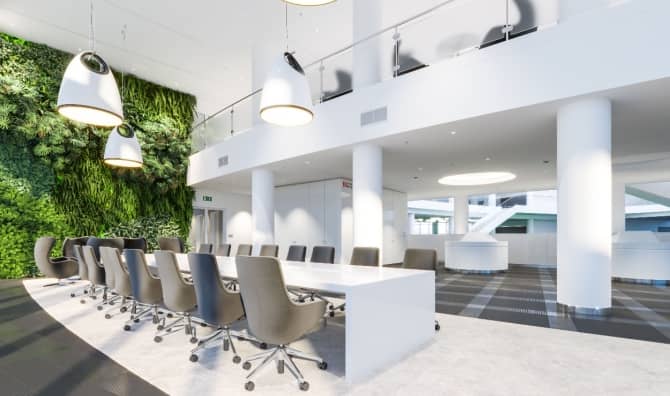
New Israeli Technology Turns Office Walls Into Living Air Filters
What if the walls around you weren’t just walls? What if they functioned not just as structural blocks holding up a building, but instead actively improved the look and feel of the room itself, making it cooler and creating a healthier indoor environment?
Green walls, vertical installations of living plants, The Jerusalem Post reports, provide a natural solution for maintaining indoor air quality. But their performance is inconsistent and maintenance is complex, limiting their use. Now, researchers at Hebrew University have developed VertINGreen, a new technology that solves this through artificial intelligence, plant data, and remote sensing to predict how green walls will perform ahead of installation and to monitor their health in real time.
The Benefit of Green Walls
According to a press release from the Hebrew University of Jerusalem, maintaining indoor air quality often involves mechanically filtering, circulating, and cooling the air at a high energy cost. Plants can help support indoor air quality in a way that’s more environmentally friendly.
According to a new study from the Hebrew University of Jerusalem, published in Indoor Air, green walls can help improve indoor air quality by reducing carbon dioxide levels, lowering room temperatures, and filtering pollutants from the air. The researchers also note that previous studies have linked green walls to lower levels of stress and increased productivity in office settings.
However, significant logistical challenges have in the past hindered the installation of green walls at scale, the press release from the Hebrew University of Jerusalem explains. It’s hard to predict how these walls will grow and respond to the environment around them. Additionally, these eco-friendly facilities can, at times, require constant and expensive maintenance.
VertINGreen
To combat these logistical stumbling blocks, researchers fed approximately 2,000 measurements related to how indoor plants absorb carbon dioxide and release water into a sophisticated artificial intelligence program. After being trained on this data, the system, VertINGreen, learned to predict, in advance of installation, how a green wall will respond to indoor conditions and how effectively it could help improve air quality and reduce energy consumption.
Even after the plants are set up, VertINGreen can continue to monitor them using hyperspectral imaging to detect changes that are invisible to the human eye. It uses this to identify stressors and potential problems before they become visible to the people around them. VertINGreen also maps plant activity in real time, helping lower maintenance costs and support healthier, longer-lasting green walls. The technology provides architects, engineers, and building managers with the necessary tools to better utilize nature inside buildings.
Integrated Hydroponics
The Jerusalem Post adds that VertINGreen is designed hand-in-hand with a hydroponic watering system that recycles water and delivers nutrients to the plants.
The system’s price tag allows it to be implemented at scale even in office towers and tall buildings, costing about $3,000 for the irrigating computer, plus the cost of inexpensive plastic pipes and PVC shields to protect the building’s actual walls.
VertINGreen offers a fresh perspective on the role of walls. It suggests a future where office walls do more than hold up the ceiling. Rather, they may be able to help people breathe easier, feel better, and bring a little more nature into everyday life.