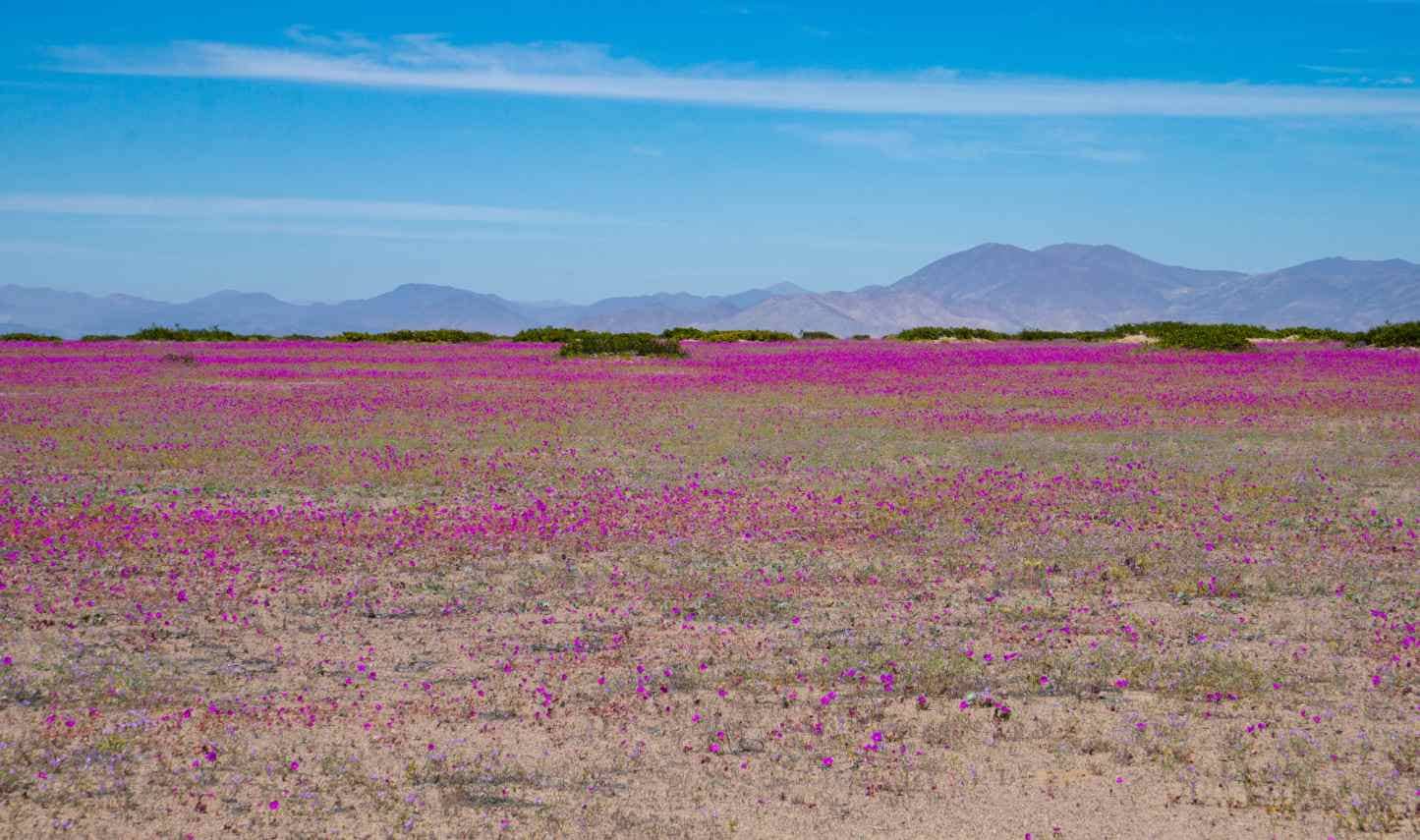
Flowers are Blooming in One of Earth’s Driest Places
The saying goes that April showers bring May flowers. But heavy downpours can trigger spectacular blooms around this time of year in one of Earth’s most arid and desolate landscapes.
The Atacama Desert stretches across northern Chile and usually features barren and sandy vistas, according to NPR. Now, with the influx of heavy rainfall, attributed to the El Niño climate phenomenon, this very desert is blanketed with vibrant flowers in a variety of colors. The unusual occurrence is drawing in scientists and thousands of visitors for a chance to see the desert in full blossom.
View this post on Instagram
A ‘Flowering Desert’
This strange occurrence is known as a flowering desert, Euronews reports. It happens because the sandy desert topsoil actually hides seeds and bulbs that remain dormant under the dry earth. When enough rain falls, many of them start to bloom.
In this case, the substantial rainfall that kicked off the Atacama’s flowering is linked to the El Niño climate pattern. Thanks to El Niño, some areas in Chile’s desert received more than 180 millimeters of rain, which is the most that’s ever been recorded there. The heavy rainfall soaked deep into the desert’s soil, helping a vast number of buried seeds and bulbs germinate.
The Atacama’s Vibrant Flora and Fauna
According to NPR, the bloom, which has spread even to areas where blooms have never been recorded before, started with delicate pale-yellow flowers. Later, pastel purple blooms also started poking their heads above the sand.
Now, the desert is blanketed in kaleidoscopic, multi-colored blossoms representing more than 200 species of plants. Some of the flowers, like the garra de león, a striking red bloom that has a tail of green leaves, are found nowhere else on Earth. Scientists also may be left wondering if the extraordinary bloom could reveal previously unknown plant species.
View this post on Instagram
The flowers also bring with them other forms of life. Insects hatch and they, in turn, draw in lizards and bats. Even larger animals, like the iconic guanaco, can be sighted during the flowering desert phenomenon.
“It’s very exciting,” seed bank researcher Ana Sandoval tells NPR. “It’s as if the desert is awakening. Sometimes people think it’s an empty, arid place, devoid of life, but actually our desert is just waiting for the right conditions, and any precipitation, to awaken it.”
Tourism and the Flowering Desert
The desert is expected to remain in bloom through mid-November and is attracting human visitors as well, ua.news reports. Llanos de Challe National Park, for example, usually only welcomes 10,000 visitors annually. This year, 15,000 tourists visited in just a few weeks.
Alongside tourists, biologists from Chile’s INIA national seed bank are also spending time in the Atacama collecting samples to study in a lab. The region’s governor, Miguel Vargas, is now seeking to have the flowering phenomenon recognized as a UNESCO World Heritage Site.
The Atacama’s remarkable transformation is a beautiful reminder that even in the most barren-looking places, life is hiding just beneath the surface. Sometimes, all it takes is a little bit of rain to set off a burst of life and color.