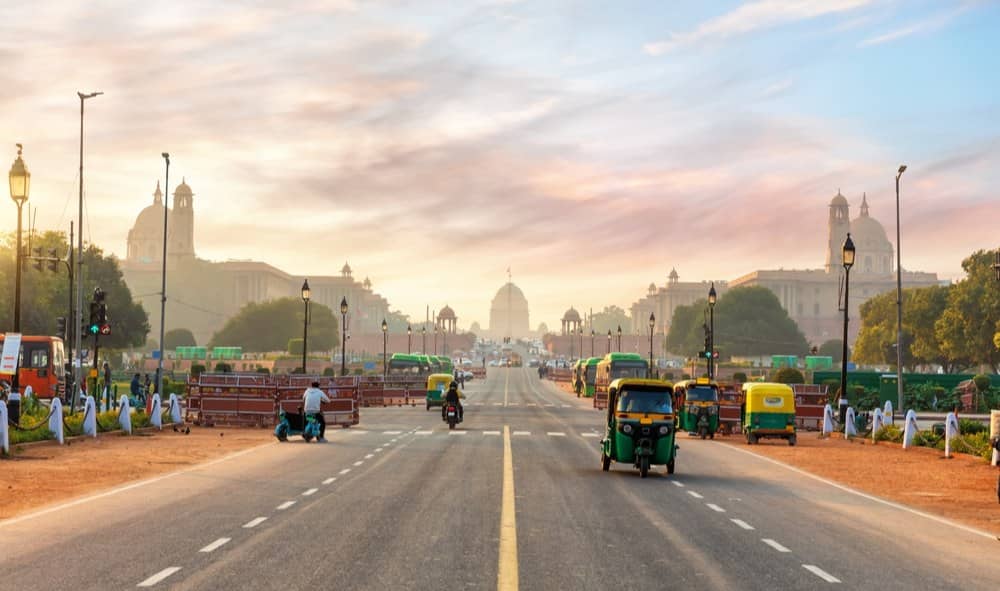
It’s Green Fields Ahead for India’s Tuk-Tuks
Compact, three-wheel motorized rickshaws, aka tuk-tuks, are going electric! And this environmentally-friendly reworking of an iconic but polluting three-wheeled urban vehicle, is transforming India’s crowded urban hubs for the better.
As the Telegraph reports, tuk-tuks are the backbone of Asia’s transport system, and new electric versions represent a revolution for the Indian urban environment. This move to electric mobility has the transformative potential to benefit all in terms of enhanced air quality and a more comfortable upgrade to urban living.
The Tuk-Tuk Revolution
Tuk-tuks are small, motorized three-wheeled vehicles with open sides and small, covered roofs. They have one front wheel, and two rear wheels, with space for a driver in front, and a small bench seat in the back for two-three passengers.
Frequently decorated in bright colors and LED lights by their owners, their compact size allows them to squeeze through heavy traffic jams in polluted megacities, which standard cars are unable to do.
Named after the rhythmic “tuk-tuk” sound of their engines, they are commonly used as taxis, especially in Indian megacities, in Colombia, Sri Lanka, and other southern Asian, as well as in southeast Asian countries such as Thailand, parts of Africa, and in Central and South America, where they are a recognizable fixture in crowded urban hubs.
Large Minority detail how tuk-tuks are known for weaving through bustling city traffic and leaving a trail of exhaust fumes behind them. Averaging 40-60 miles per hour, they can reach 80 miles per hour.
These familiar vehicles hark back to the post World War II era, first originating in Japan.
Their budget-friendly convenience meant that it was not long before they spread throughout Asia, morphing into today’s go-to vehicle for short-distance city travel.
Tourists have come to associate them with faster travel in hectic city hubs. No tinted windows or air conditioning here! Riding in one means being part of the action, and experiencing the crowds, aromas, and culture of an area up close!
More About Electric Tuk-Tuks
New, electric tuk-tuks are zero-emission mobility solutions that are being warmly welcomed for their improved safety, advanced design, and functionality, as Large Minority details.
According to CBC News, electric rickshaws can also fit more passengers on the bench at the back.
The Telegraph salutes what it terms a quiet revolution in the developing world as these noisy, gas guzzlers turn electric. While North America and Europe have concentrated on cars. Asian cities feature tuk-tuks increasingly powered by batteries instead of hydrocarbons.
This development is groundbreaking as it has the potential to transform some of the globe’s most polluted cities such as Delhi, Bangkok, Mumbai, Dhaka and Hanoi to smog-free cities with clean air, even if the motivation is lower costs rather than environmental quality:
“The market is booming now, a decade after it emerged,” Sunitha Anup, a researcher at the International Council on Clean Transportation tells the Telegraph. “Climate change is a secondary reason for the shift – the first is cost.”
The Telegraph observes that the shift from gas to battery-powered tuk-tuks is most apparent on India’s chaotic roads, which feature rickshaw cargo trucks and waste collectors as well as rickshaw taxis.
While around a quarter of global three-wheeled vehicles sold in 2025 were battery-powered, in India, this figure reached over two-thirds of sales according to the International Energy Agency (IEA), with this IEA chart showing a 68 percent share of sales in 2025.
The Telegraph visited a factory belonging to company Atul Greentech in the western Indian state of Gujarat to take a new battery-powered tuk-tuk for a test drive. It chose a premium model which sells for around $4000 (though one can find models for half of that price.) It found the vehicle to offer a smooth ride, with a good steering system and breaks. Most strikingly, it is eerily quiet!
According to company director, Divya Chandra, this, the brand’s most advanced EV to date, has a range of 137 miles (220 kilometers) per charge, can carry 772 pounds (350 kilograms) in weight, and has a maximum speed of 28 miles (45 kilometers) per hour. He sees a future in which 100 percent of the rickshaws made by Atul Greentech’s legacy parent company, Atul Auto, will be electric.
Importantly, in India and other Asian markets, where two- and three-wheeler vehicles still dominate the market (92 percent of vehicle sales were mopeds and rickshaws in 2025, the Telegraph reports), it is easier to turn electric, as Rahul Maity, an EV consultant at Delhi-based JMK Research & Analytics shares. This is because these vehicles require a much smaller investment than electric cars.
The Indian government continues to encourage and subsidize domestic EV production to meet its strategy to cut carbon emissions, as CBC News reports.
Significantly too, battery costs have fallen, with battery swapping schemes already in place to combat a shortage of charging stations and consumer investment, as this World Economic Forum video documents, making running an electric vehicle cheaper and easier than running a petrol-fuelled one.
“India is the largest three-wheeler market in the world,” Chandra says. “I would say the future [for electric tuk-tuks] is not bright, but extra bright,” he predicts.