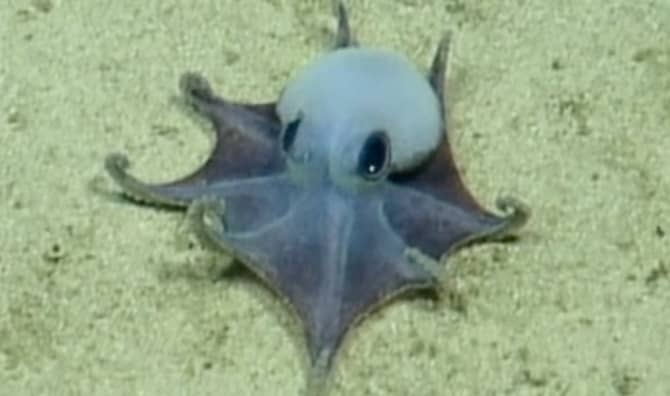
Scientists Discover a Tiny Blue Octopus Species
Octopuses are marine mollusks that are found in every ocean of the world and are known for their bulging eyes and eight long arms. There are 300 species that come in a variety of sizes and colors, but they are rarely described as cute. At least until now.
A tiny blue octopus that is small enough to fit in your hand was first spotted in 2015 by researchers near Darwin Island in the Galápagos Islands, reported CNN. The researchers were aboard the submersible Nautilus and spotted a flash of blue and then zoomed in to spot a tiny eight-armed creature.
The researchers scooped her up using an underwater robot and brought her into the sub. She was later cataloged and saved in the collection of the Charles Darwin Research Station. There the specimen remained, unexamined until 2017.
A Rare Specimen
In 2017, researchers were going through photos of the specimens in the station’s collection and realized that the little octopus was clearly something different because it didn’t match any known species, according to SciTechDaily.
They sent a photo to octopus specialist Janet Voight, who is the curator emerita of invertebrates at the Field Museum in Chicago and the lead author of the recent study describing the new species. “I’d never seen anything like it,” she told SciTechDaily.
The scientists sent the sample to the Field Museum for Voight to examine but studying it was problematic. There was only one sample, and Voight didn’t want to dissect it.
She partnered with Stephanie Smith, manager of the field museum’s X-ray computed tomography laboratory to create detailed CT scans.
“Because CT imaging is non-destructive, it’s especially important for type specimens like this one. And that’s great for me because people are often bringing me these incredibly rare and stunningly beautiful specimens that I get the privilege of virtually opening up,” said Smith, a co-author of the study describing the new species. “There’s nothing like spending the day looking at something no other human has ever seen.”
Why Discovering New Species is Important
The new species was named Microeledone galapagensis. While it is not an earth-shattering discovery, it is still valuable, according to CNN. That’s because 91 percent of marine species haven’t been discovered. Meanwhile climate change is affecting and endangering marine life.
“Climate change is penetrating the deep sea,” Jim Barry, senior scientist at Monterey Bay Aquarium Research Institute in California, who was not involved with the study, told CNN. “That is changing some of the systems in the deep sea and ecosystems in the deep sea before we even really know what’s there.”
Now is the time to protect the oceans and the creatures who dwell there before more environmental damage is done.