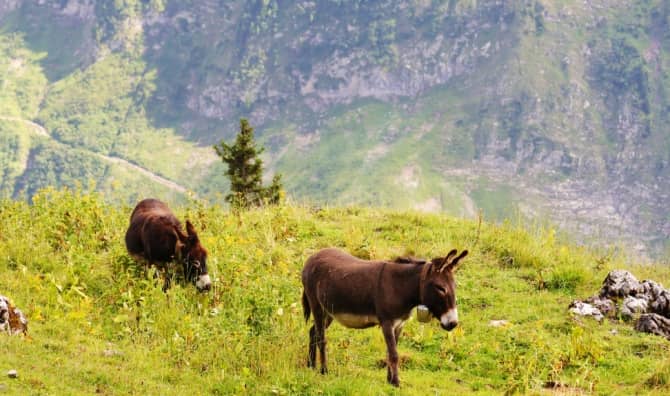
Spain’s Firefighting Donkeys are Preventing Blazes
Donkeys have a reputation for being cute, but stubborn. And though many may consider them as simply the oft-overlooked cousin of the more popular horse, in reality donkeys and humans have been living and working together for millennia.
Now, according to National Geographic, donkeys are once again being used to help humanity in a new, creative way — preventing firefighters by consuming the brush that the fires feed on.
Combatting Forest Fire
Spain, like many places in the world, has a wildfire problem. As climate change begins to wreak havoc on weather patterns, leading to hot, dry summers, the dangers of destructive wildfires grow. In 2025 alone, almost 1 million acres of land had burned across Spain. Six Spanish regions were declared disaster zones.
However, there is one area that has, so far, been saved from the destructive horrors fire brings with it. Since 2014, 18 donkeys, all saved from abandonment, have been circulating the area around Doñana National Park happily munching on the dry, rough grass and tree branches — the very material that could easily burst into flames with the advent of a fire.
As it turns out, donkeys are uniquely suited to consume this type of vegetation. Unlike other large herbivores, such as cows and goats, they do not have a complex stomach, which means they can chew the same food repeatedly and are able to ingest types of grasses that other animals cannot. The donkeys are living their best lives, wandering around unbothered by people; all the while preventing wildfires at the same time.
Amazingly, the donkey strategy has worked, and the park has not had a wildfire in over nine years.
Spreading to Other Regions
The success of the Doñana National Park project, according to EuroNews, has led to the donkey model being adopted in other regions of Spain. From Tivissa to Catalonia and Galicia, numerous donkey projects have sprung up. For instance, the Tivissa project, which began in 2020, started with merely three donkeys. Now, it has 40, and the area has not had a wildfire in six years.
Once, donkeys were humans constant companions, working in the fields with them and traveling with them to and fro across the landscape. Little did humanity know, but donkeys were also helping them in ways they could not fathom. By traversing the landscape, donkeys engineered their environments, eating brush, knocking into dead wood, and keeping the area clear of quick fuel for fires. Now, with the advent of machinery and cars, donkeys have disappeared from everyday life, and with them the secondary benefits they afforded.
The projects in Spain show that sometimes to ensure the future you must look to the past and try to understand the ways in which the changing world can be reigned in with the help of some slow-chewing donkeys.