This Boat Chomps Through Plastic Ocean Trash!
Here’s some welcome news about our environment! As the Guardian reports, an innovative, automated, solar-powered fleet of boats, known as “Interceptors” are scooping up plastic trash including crates, bottles and tops, polystyrene takeout containers, and noodle cups from the sea’s surface. These vessels are winding their way through polluted ocean and river waters in ten different global locations.
Tackling this trash is urgent because, as Whale and Dolphin Conservation – North America highlights, plastic pollution remains a global environmental crisis, because it never goes away.
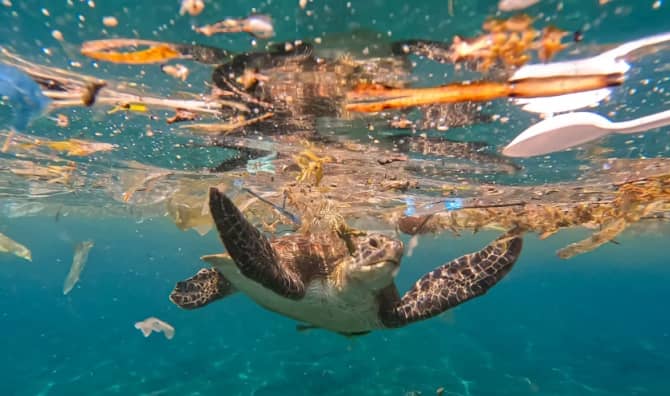
Over time, while some of the vast quantities of plastic waste are broken down into smaller fragments through exposure to the weather, and to waves, it never really disappears. It just breaks down into smaller pieces that become microplastics. These are ingested by marine life with harmful consequences to fish and later on humans, as they enter the food chain.
Ocean Cleanup Crusaders
Boyan Slat is the Dutch inventor and entrepreneur who founded the environmental engineering nonprofit Ocean Cleanup.
Ocean Cleanup is focused on creating and deploying technology to extract plastic pollution from the world’s oceans, and to capture it in rivers before it even reaches the ocean.
This crusading Netherlands-based organization is responsible for the development of the “Interceptor system” a unique barge system scoping up this plastic waste from the ocean and rivers that feed into them. As the Guardian details, 21 Interceptor systems operate in 10 locations around the world, in countries including Malaysia, Indonesia, Vietnam, Jamaica, the Dominican Republic, and Guatemala.
Slat was originally moved to use technology to tackle the Giant Pacific Garbage Patch, which Ocean Cleanup explains is located halfway between Hawaii and California in the Pacific Ocean, and is the largest accumulation of ocean plastic in the world. It is estimated to cover an area twice the size of Texas, or three times as big as France.
Battling garbage patches like this one is vital. UNEP estimates that 19-23 million tonnes of plastic waste leak into aquatic ecosystems, polluting lakes, rivers and seas every year. It also estimates that approximately 7,000 million of the estimated 9,200 million tonnes of cumulative plastic production between 1950 and 2017 became plastic waste.
More than half of this plastic trash is less dense than the water, meaning that it will float once it hits the sea. As more and more plastics are discarded into the environment, they are transported offshore by converging currents, finally accumulating in patches of trash such as this one.
How do Interceptors Work?
An interceptor vessel is actually made up of two barges with a smaller platform nestled inside the larger boat.
A floating barrier steers plastic trash into the device, where a conveyer belt then scoops it up, after which an automated shuttle distributes the waste into six dumpsters on a different barge that can hold a total load of about 20,000 pounds (9,070 kilograms) of plastic pollution, the equivalent of a fully loaded lorry. Solar panels make up the ceiling overhead.
Later on, the waste is sorted and shipped to refuse facilities and sorted or stored responsibly. This is to avoid what James Patterson, the nonprofit’s operations manager called “a circular battery of trash” in conversation with the Guardian.
To date. The Interceptor’s track record is impressive. It has already stopped more than 143,000 pounds (64,864 kilograms) of rubbish from entering the Pacific from one LA river, according to the newspaper.
Cleaner Seas Tomorrow
In looking into solutions to garbage patches on the surface of oceans, Ocean Cleanup has pivoted to rivers, the arteries that carry trash into the world’s oceans. The pressing goal became preventing plastic pollution from reaching the ocean in the first place. This is a key goal because Ocean Cleanup’s research, the Guardian details, shows that just 1,000 of the world’s rivers are responsible for almost 80 percent of plastic emissions into the ocean.
As Patterson clearly explains to the newspaper: “We have to turn the faucet off before we can scoop the ocean, or else all we’re doing is taking out legacy trash to replace it with new trash.”
Eventually, however, as Patterson shares with the Guardian, “Instead of specific rivers, the goal is to clean up an entire area, because that’s how you get an actual genuine impact on society and on the environment.”
This is already happening! Ocean Cleanup is new deploying river-based Interceptor solutions that fit into local waste management infrastructures. Its flagship project in Kingston Harbor, Jamaica, one they call “Interceptor city,” is the first to feature multiple Interceptors in one city, laying the groundwork for a more efficient approach to intercepting plastic before it reaches the oceans.