Wildlife Makes a Remarkable Comeback 40 Years After Chernobyl
This is a remarkable story of biodiversity flourishing in the most unexpected places. Forty years after the Chernobyl nuclear disaster in Ukraine, the contaminated exclusion zone surrounding the former nuclear power plant has become an unlikely haven for wildlife.
Spanning parts of northern Ukraine and southern Belarus, the zone remains largely off-limits to human habitation, particularly in areas where radiation levels are highest AP News reports. Yet, in the relative absence of people, wildlife has not only returned but, remarkably, thrived
Today,this radioactive landscape is home to a surprisingly rich diversity of wildlife, including large mammals such as wolves, lynx, Przewalski’s horses and wild boar. Their presence offers a striking testament to nature’s resilience, although the long-term effects of radiation exposure on wildlife, including genetic mutations and other biological changes, remain a subject of scientific study. As World Nuclear News notes, while parts of the exclusion zone remain strictly off-limits, others are accessed daily by workers and visitors, and a small number of people have even chosen to live there.
Large areas of the Ukrainian and Belarusian exclusion zones have since been designated as protected wildlife reserves, together forming one of the largest contiguous protected natural areas in mainland Europe. The United Nations Development Program has described the region as Europe’s largest rewilding experiment.
Adaptation Versus Radiation Stress: The Biological Toll of Chernobyl
The biological fallout of the worst nuclear accident in history has been extensively documented. The BBC reports that in the immediate aftermath, radiation devastated local ecosystems, and killed large numbers of animals,
One of the most striking examples was the Red Forest, a roughly four-square-mile (ten-square-kilometer) area near the reactor, where pine trees turned reddish-brown after radiation absorption.
As The Conversation explains, the initial radiation exposure inflicted severe damage on both plant and animal life, with scores of mammals and other creatures perishing.
The long-term effects have been documented in surviving wildlife. Studies have reported cataracts in voles, developmental abnormalities in insects, albinism and tumours in barn swallows, and darker pigmentation in Eastern tree frogs, possibly linked to the protective effects of melanin.
Yet Chernobyl’s ecosystem also reveals signs of biological resilience. Some studies suggest that certain organisms may develop enhanced DNA-repair mechanisms or undergo evolutionary changes that improve their tolerance to radiation. Remarkably, black fungi have also been found thriving inside the damaged reactor, while surrounding forests have shown unusual patterns of growth.
However, the extent of such adaptation remains debated. As the BBC notes, distinguishing radiation-induced damage from the effects of other pollutants, particularly heavy metals, is challenging. More importantly, apparent biological resilience does not necessarily indicate genetic adaptation. Determining whether these changes reflect genuine evolutionary responses or are simply the consequences of prolonged environmental stress remains one of the central challenges in understanding Chernobyl’s extraordinary ecosystem.
When the People Moved Out, the Animals Moved in
In the aftermath of the 1986 disaster, many expected the surrounding landscape to remain biologically devastated for generations, according to The Conversation. Instead, the withdrawal of human activity created an unexpected refuge for wildlife. With farming, hunting and settlement largely abandoned, animal populations began to recover across vast, interconnected areas.
Populations of large mammals in parts of the exclusion zone are now comparable to or even higher than those in uncontaminated nature reserves, suggesting that the benefits of reduced human disturbance can outweigh the effects of low-level radiation.
According to Eco News, some 116,000 people were evacuated from an area spanning some 1,660 square miles (4,299 square kilometers) across Ukraine and Belarus. In their absence, intensive agriculture ceased, roads fell quiet, and cultivated fields gradually reverted to scrubland and forest. Predators gained territory, while conflicts involving livestock, hunters and expanding settlements diminished.
A landmark 2015 study published in Current Biology, examined wildlife populations in the Belarusian exclusion zone. It found that moose, roe deer, red deer and wild boar populations were broadly comparable to those in four uncontaminated nature reserves. Wolf numbers, remarkably, were more than seven times higher. Brown bears, European bison, foxes and Eurasian lynx, have also established a presence.
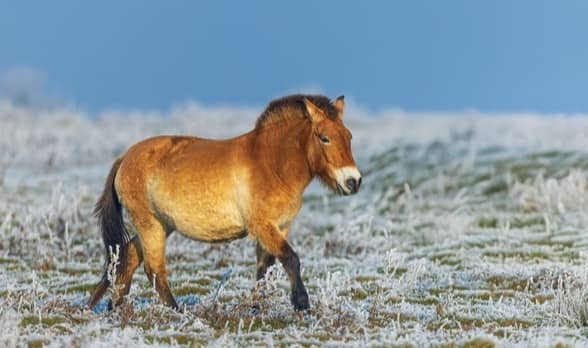
One notable newcomer is the endangered Przewalski’s horse, a stocky, caramel-colored wild horse native to Central Asia. Unlike the other returning wildlife, it was deliberately introduced into the exclusion zone in 1998.
Wildlife has also found unexpected uses for the abandoned landscape. As YNet reports, camera traps have captured Przewalski’s horses sheltering in deserted barns, escaping harsh winter conditions and summer insects.
Denys Vyshnevskyi, the exclusion zone’s chief nature scientist, captures this transformation in an interview with Ynet: “For those of us in conservation and ecology, it’s kind of a wonder. This land was once heavily used — agriculture, cities, infrastructure. But nature has effectively performed a factory reset.“