Canadian Teen Built a Robot Turtle to Keep Waterways Healthy
In recent decades, technology has made major strides in addressing environmental challenges. New inventions help gather information and apply solutions to keep Earth green and healthy. However, sometimes, the most creative ideas come, not from new technology, but rather nature itself.
Evan Budz, a high school student from Burlington, Ontario, Canada, is a young engineer making waves after being inspired by snapping turtles’ natural graceful locomotion to create his own turtle bot, Popular Science reports. The teen’s invention glides soundlessly through aquatic environments without disrupting them, while also collecting data on ecosystem health.
Inspired by Nature
Evan has long aspired to apply his skills and talents to helping the environment. He told Popular Science, “My parents brought me up with the sort of principle that every place that I visit, I should leave it a bit better than I found it.”
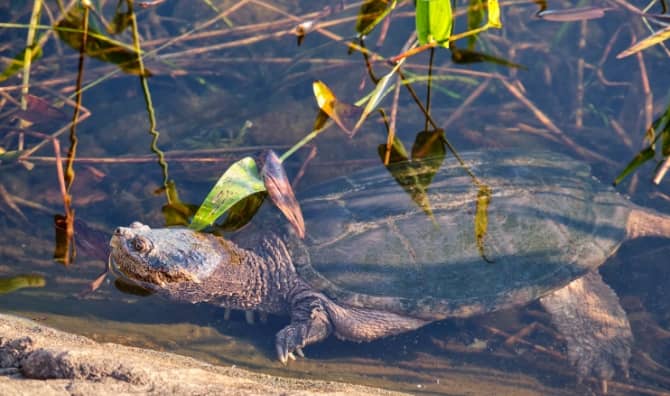
However, Evan became inspired to create the robotic turtle, BURT (a nickname that stands for Bionic Underwater Robotic Turtle), only after a camping trip brought him into contact with snapping turtles. Evan became fascinated watching these agile reptiles propel themselves through water.
“When I saw the snapping turtle,” Evan said, “it was so graceful, fluidic, and generally non-disruptive” to its surroundings. I thought it’d be really interesting to go and try and replicate its natural swimming [motion].”
View this post on Instagram
Designing the Prototype
Initially, Evan studied turtle movement by analyzing videos and consulting local experts. He learned that turtles use their front flippers to propel while the back legs guide, stabilize, and steer. Equipped with this knowledge, Evan designed a prototype using SolidWorks’s engineering software.
He tested the prototype in his grandparents’ pool but the early attempts were not successful. The final design included four flippers and a hollow acrylic tube, housing an AI-powered microcomputer, various electronic components, and a lithium battery with eight hours of charge.
Although, BURT is smaller than an average turtle, allowing it to maneuver with ease, its locomotion is remarkably similar to that of a natural turtle. Evan told Popular Science that this allows it to monitor aquatic ecosystems without disrupting them.
“Most current underwater technologies can produce things like noise from their propellers or very high-pressure water streams,” Evan explained. “I don’t want to harm the various places that I’m hoping to protect.”
View this post on Instagram
Monitoring Underwater Environments
Evan also equipped his robot turtle with various sensors and components allowing it to monitor underwater threats, including a front camera and an AI that Evan trained in his grandparents’ pool using 3D modeling.
Evan shared that, “I basically went out and created a simulated coral reef setup using 3D models and the turtle then swims around them to simulate what it would do in a real-world environment.”
The Hamilton Spectator reports that the bot detects coral bleaching with 96 percent accuracy. In recent months, Evan also designed and added a holographic camera system to detect microplastics in the water.
An Award Winning Design
Evan won first place at the 2025 Regeneron International Science and Engineering Fair for the microplastics detection system alone, in addition to several other awards for the turtle prototype itself. He told The Hamilton Spectator, “It was surreal to hear my name announced. I hope my project has helped raise awareness about the threat microplastics pose to aquatic ecosystems and the importance of environmental research.”
BURT shows how nature can inspire solutions to real-world problems. Sparked by watching a turtle swim in the wild, a gifted and inventive teen created a robot that can help protect and study underwater ecosystems.