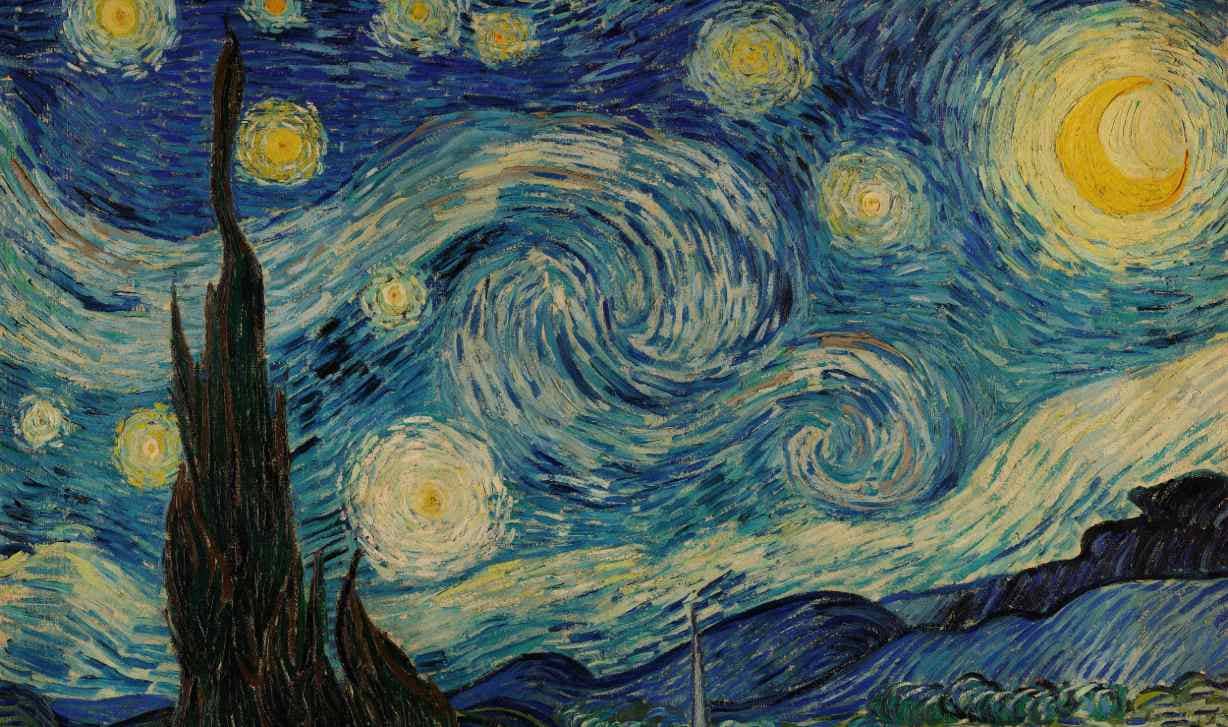
Van Gogh’s ‘The Starry Night’ May Have Been Inspired by the Real Sky
Vincent van Gogh’s masterpiece, “The Starry Night,” has dazzled and astonished art lovers, amateurs, and experts alike. The painting depicts a swirling, kinetic sky, bright with stars, over dark hills. For years, much of that sky was interpreted as a product of Van Gogh’s imagination.
Now, however, that assumption is being called into question after a group of South Korean astronomers published a study in Scientific Reports claiming that through the use of modern astronomical and historical analysis, they identified the dawn around July 22, 1889, as the closest match to the sky depicted in ‘The Starry Night.’
A 40-Year Investigation
According to Space, efforts to identify the sky painted in The Starry Night began more than 40 years ago, in 1984. The investigation involved an art historian and two astronomers analyzing the sky depicted in the painting over the years. However, different teams came to various conclusions, and no consensus was reached.
More than 40 years later, a South Korean team led by Elijah Jeong-hyun Kim, the CEO of South Korean robotic telescope company SLLAB and a Ph.D. candidate at Kyung Hee University’s School of Space Research, took up the task again. The team started by analyzing the historical sky over Saint-Rémy, the location where Van Gogh painted The Starry Night, and mapping its celestial arrangement.
The team then used a technique called astrometry, which allows an image of the night sky to be compared with stored celestial coordinates, along with Procrustes analysis. Using these methods and historical evidence, they came to the conclusion that the painting closely matches the pre-dawn sky around July 22, 1889, when the waning crescent moon, Venus, and the Hyades cluster were visible together.
An Art History Mystery
The astronomical discovery may challenge what was previously thought to be the timeline of the painting, CNN reports. For more than a century, much of the painting was believed to come from Van Gogh’s memories and imagination, while art historians traditionally dated the piece to mid-June 1889. This is based on a letter that Vincent van Gogh wrote to his brother, Theo, around June 18, in which he relayed, “At last I have a landscape with olive trees, and also a new study of a starry sky.”
A Closer Look at the Sky
The June timeline also raises questions. With the summer solstice approaching, the pre-dawn sky around June 19 would not have displayed the kind of memorable stars captured in the painting. There are some biographical issues with the July date, as well. Van Gogh was long thought to have suffered a seizure in mid-July 1889 that may have left him unable to work for weeks.
However, a re-examination of original French and Dutch letters, along with weather records, suggests that the seizure may instead have occurred in late July and lasted only a day or two. A previous examination of the canvas also found evidence that Van Gogh planned the placement of the stars in advance and painted them after the surrounding blue sky was completed. Together with the new evidence, this leads to the possibility that Van Gogh began developing the work in June and finished it later in July.
Still, outside experts urge caution. In art, it is never entirely clear when an artist is working from observation or is just using what is called artistic license. It is equally possible that Van Gogh just preferred a crescent moon and chose to paint it instead of a fuller one he may have observed even if it didn’t match the sky he saw.
Exactly when The Starry Night was completed and how closely its sky reflects what Van Gogh observed may remain uncertain. But whatever the case, the new study is a fascinating look into how science and art can converge and may shed light on one of the world’s most famous paintings.