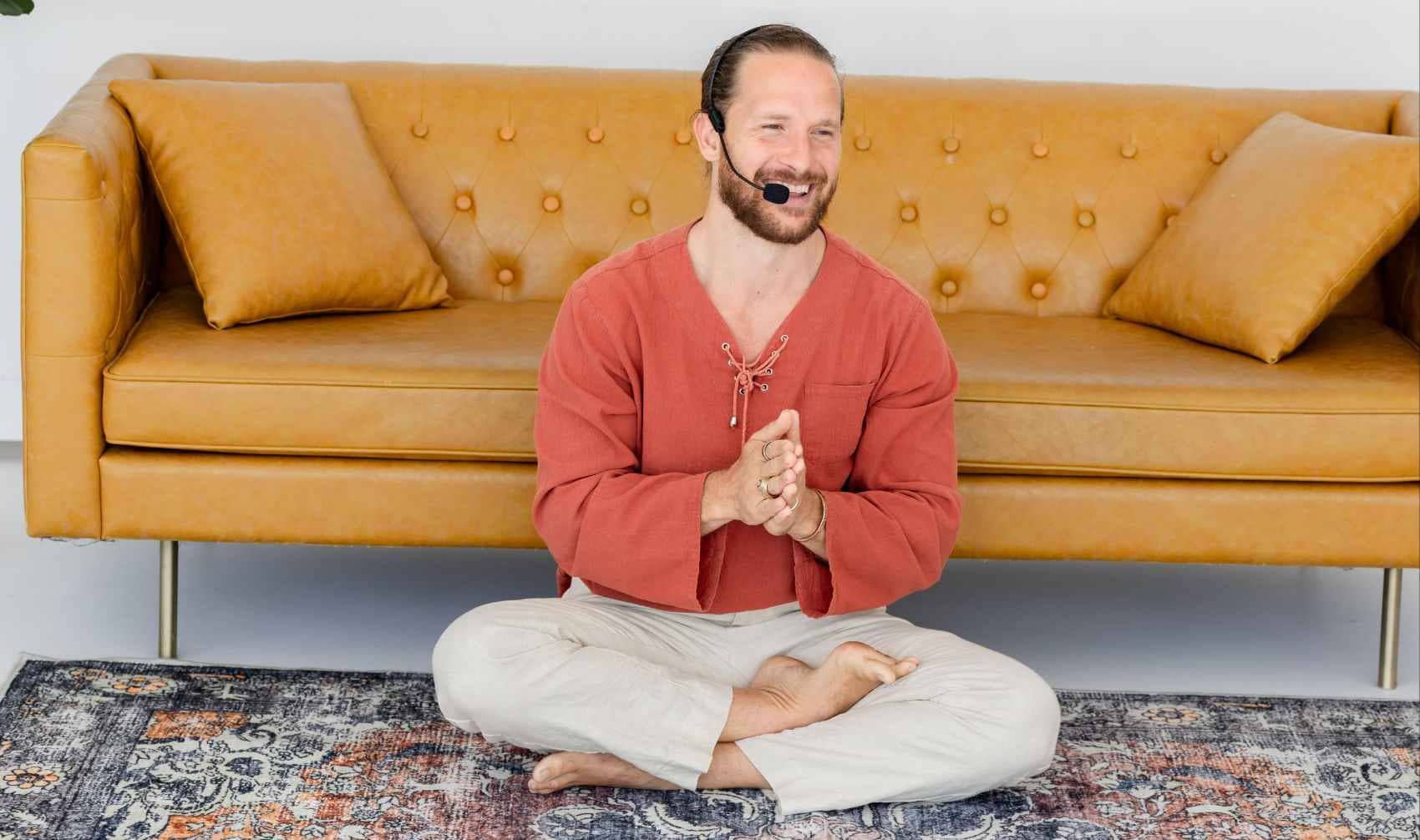
Justin Peters on Reclaiming Your Power and Healing the Relationship With Yourself
This episode of The Goodnet Effect: Echoes of Inspiration features a conversation with coach Justin Peters (@justnthemoment), offering practical tools for building self-worth, breaking free from limiting beliefs, and reclaiming your inner power.
Peters reveals the “maps of reality” that keep us stuck, why awareness is always the first step to transformation, and the practices, including affirmations, meditation, and breathwork, that can help you stay grounded in your worth. He also discusses trust, self-compassion, forgiveness, letting go of relationships that no longer serve you, and why healing the masculine and feminine within ourselves can lead to healthier relationships with others.
Having trouble seeing the podcast? If the YouTube player isn’t showing up, it’s likely because you haven’t accepted cookies. Click here to watch the podcast.
Scroll down for a transcription of this episode
EJ: Hello, and welcome to The Goodnet Effect: Echoes of Inspiration. I’m your host, Erica Jackson, and we are at Essence of Life Radio, which is part of the Arison Group. This is the place where we meet inspirational people that are changing the world and the way we think. Goodnet is an inspirational good news online media platform founded by businesswoman and philanthropist Shari Arison. It has a mission of sharing positive stories, stories of personal growth, and ones that inspire real change.
And with that, I would like to welcome Justin Peters to the podcast. He’s known as justnthemoment on social media. He is doing incredible work in this world. He’s a coach that helps people heal the relationship with themselves so they can have extraordinary relationships with others. Justin, thank you for being here. We have a lot to talk about today.
JP: I’m so honored to be here. It’s such a privilege and pleasure, and to be a part of a show with a mission like you guys have. There’s so much of what’s wrong going on in the world, and you guys are like, well, wait a minute, there’s also a lot of what’s going right. Let’s highlight that. And I think it’s such a testament to the healing path, the transformational path, and just love what you guys are doing. So I’m excited to share my story and have a beautiful conversation with you.
EJ: And we’re so excited to have you here as well. I want to start with the relationship we have with ourselves, because so much of your work begins there. How important is understanding your own worth and inner power in breaking free from limiting beliefs and unhelpful mental loops that keep us stuck?
JP: You know, one of my favorite quotes by a guy I look up to a lot, Michael Singer, he says, “In our modern-day world, we try to have the external world take care of the internal world.” And what I have found out is that it’s totally backwards because I’ve gone after the external things, the money, the recognition, the success, the material items, and without detachment. Don’t get me wrong, they can be beautiful to have in this life. But if we’re depending on them to make us happy, or whole, or complete, we’re missing the whole point.
And so when we flip that, that quote around, what it’s really saying is the internal world takes care of the external world. When we work with ourselves, when we find wholeness within ourselves, when we find abundance within ourselves, when we find all these things that we think we’re going to get once we receive something externally, we realize we already have it right here, right now.
And a big part of my work and the work that I teach is like, hey, wait a minute, we don’t have to go out and find anything. If we want to really manifest the relationships we want, the money we want, the life that we want, it all starts inward first. Let’s take care of the internal world. Let’s have gratitude, appreciation, and acknowledgment of what we do have so we can be in resonance of that feeling, because it’s never the things we want. It’s the feeling that things give us, right?
And so the whole work becomes, how do I create that feeling here and now so I can attract and become in alignment with the things that I know can bring additional value and happiness into my life? And, you know, the beautiful thing about having the relationship with yourself be the priority is you get to take your power back. You know, you get to really take your power back. Because so often, I know for me at least, it’s like if they could have changed or if this would have gone differently, then I could have been okay, then I could have been happy.
And it’s like, well, wait a minute, do I really need someone else to be a certain way in order for me to be happy? Do I really need something to happen outside of me for me to be okay? Or can I start taking my power back fully to say, I can be okay here and now, and no matter what’s happening on the external world, it’ll naturally take care of itself?
EJ: And when a person becomes rooted in their own worth and power, and when they make self-actualization their mission in life, what really becomes possible for them? Who can they become? What can they create and attract from that place?
JP: They can attract exactly what they came here for. I think so much of the work is unraveling the conditionings. I call them maps of reality.
You know, when we’re young, we have these beliefs and these things that happen to us, and we’re like, oh, this is how the world is. And we box ourselves in based on what we’ve been taught, what our parents told us, what our friends told us, what our teachers told us, what the environment showed us. And from that point, once we establish our maps of reality, we defend, we distort, we delete. We generalize all of it because it’s like, this makes me safe. This is certain. And if I don’t have this, then anything outside of this is uncertain. And that kind of scares me.
We are students, and so to remind ourselves we’re students and to bring back those maps of realities and just get curious about our conditioning, the way we’ve been trained and programmed, and to just ask this question, like, is this really me? Is this really me? And the more we can ask that and just be real with ourselves, authentic with ourselves, and become aware of what the mind is trying to tell us reality is, then we can start to change it.
Awareness is always the first step to transformation. There’s really no addition that we need to add to it. It’s just subtraction. Let some of this stuff go, and then once we undo the layers and keep pulling them back, beneath all of it is our truth. And from that truth, you find your mission, you find your gifts. And, you know, one of my, one of my philosophies is you being the real you underneath all that is your gift that you get to give to the world. And that becomes some of the deepest and greatest and, quite frankly, the hardest work of a human here in this wild, beautiful experience we have.
EJ: And life is a journey. It has its ups and downs. And so how do you embody self-worth and inner power in a practical way? What happens when you’re going through a difficult time and you feel like you’re in a rut and you’ve, you’ve, you’ve kind of gone away from your power? How do you stay connected to your sense of worth, then?
JP: Yeah. Such a beautiful question. It’s… it’s repetition. You know, like I said earlier, we’ve programmed ourselves to find evidence for what we see reality as, and we can reprogram ourselves to see the opposite. And so, on the healing path, you know, the beautiful thing about it is, like, we can have days where we feel really good and powerful, and then it’s like, whoa…
EJ: Could be the opposite.
JP: Yeah. We’re like…
EJ: What happened?
JP: Yeah, wait, I’m not that person.
And then whenever these old patterns come in, these old ways of thinking, neural pathways are like, wait, is that me, or am I this other person that I was just feeling good about? In those moments, that’s when we, you know, it’s like the saying goes: “Neurons that… that fire together, wire together.” Right? And so in those moments when those old neural pathways are coming in, that’s when it’s most important to reaffirm, to be gentle with ourselves, and to remind ourselves of our power.
And so I’m huge on affirmations, incantations, reminding it. I’m not just trying to say words and, like, oh, I’m… I feel good all the time, and just expecting to feel good. When I say an affirmation like, “I am a man who is a child of God. I’m a man who has all the power. There’s infinite amounts of source and supply running through me,” and whenever I say that, I feel it, I believe it, and those bring me back into the present moment. Wait a minute. I’m not the mind. I’m not these thoughts that are coming in. I’m a child of the infinite. The one that created everything that I admire also created me.
And that reminder in those moments is what really reaffirms and gets us back on the track of remembering, hey, we got this. We are whole, we are special. We do have what it takes. And these… these parts of our mind, the mind monsters, you could call them, they’re just here as a gift to teach us and to show us and to redirect us back into harmony and our true self.
EJ: Are there any other practices, aside from affirmations, that you recommend?
JP: Yeah, meditation is a huge one. Being able to just sit with your thoughts and observe and understand that, wait a minute, these thoughts are happening. The mind is always moving. It’s like a wild stallion. But I’m also this infinite consciousness that’s just kind of watching the mind. What’s up with that? Am I the mind, or am I this calm, equanimous part of myself that’s watching the mind?
And once we can do that, we get to limit the power of the mind. We still get to use the mind, but we get to say, wait a minute, if the mind’s not me, if it’s based on all these conditionings and beliefs and experiences, who am I that gets to watch the mind? And once we can discern and dissect between those two, it limits all of the, the difficult thoughts, the patterns that don’t serve us, and allows us to just see the mind as it is. To observe it, to allow it to rise, to allow it to pass like a cloud coming in and then leaving, and then us being able to see the inevitable nature of impermanence that’s happening inside of it.
And another piece that I love is… is breathwork, working with our breath. It’s like the greatest ally in the world that can calm us. It can activate us. And so I’m big into yoga, I’m big into breathwork, pranayamas, and just really allowing my, the parts that God gave us the… to really work with and… and to know that, like, there’s a breath that I can take at any moment that can bring me back into awareness, calmness, understanding, to know that I’m safe, I’m okay, and all is well. And so those are my main practices that I have for sure.
EJ: And one of the things you talk about a lot is trust. How do we trust we’re being guided when things aren’t going our way?
JP: This is what I would consider one of the, the harder questions, you know, is because how do we, in the storms, trust that there’s going to be the rainbow afterwards?
And one of the ways I love to work with this is to remember all the times I’ve gone through storms, all the times I’ve gone through the hard challenges, and all the times that I’ve grown, become wiser and stronger because of them.
And so when, when times come where, you know, we… we don’t know what’s on the other side, it’s difficult. There’s no light at the end of the tunnel, it seems like. We just remember our power by remembering what we’ve already gone through. That evidence is always there.
EJ: And I want to dive deep into emotions. There’s a phrase we hear a lot in spiritual communities and healing work, which is, “You have to feel it to heal it.” And I think there’s so much wisdom in this quote because you never want to suppress what’s coming up. But at the same time, I believe those emotions can sometimes disconnect us from experiencing our own divinity. How do you fully feel what you’re experiencing without letting your emotions define your reality?
JP: Oh, such… this is…
EJ: It’s a paradox. It’s a big paradox.
JP: Yeah, yeah. This is where the… the deepest work comes in. How can we transform and transmute all of our pain, all of our feelings, back into the greatest force of all, which is love, right? That’s a big part of my teaching as well with my clients.
And so much of this, for me and my practice, comes down to seeing all of our emotions, all of our feelings, everything we’re going through, as teachers, as part of our team. You know, how often have we been sad? It’s like, oh, I don’t want to be sad, or I don’t want the fear. I don’t want any of this. What if all of those are just here to serve you in some capacity?
EJ: How important is self-compassion? What role does it play when it comes to healing?
JP: One of the biggest… we’re students of Earth. We are students. We’re not masters of this, and we have to remind ourselves of that.
With this cultural norm we’re in — of Instagram and highlight reels and thinking that everyone’s got it figured out and we’re the only ones who don’t, it’s not the case. You talk to all of my friends that have millions of followers on Instagram, they go through some of the deepest shadows. They’re in it. It doesn’t equate to reality.
And so we have to just remind ourselves that this is a process to give ourselves grace and gentle. We got thrown on this gigantic floating rock that’s floating in infinite amounts of space, and with that, we can create fun out of it. We can create play out of it. We can zoom out a little bit.
You know, one of my favorite quotes is, “When in doubt, just zoom out.” Zoom out and really see it for what it is. Everything around you has been created by people just like you. It’s all made up. Everything is just made up from this human species that’s connected to this infinite intelligence. And once we can understand that, we can let go of these restraints, limitations, have some compassion with ourselves by having more play, more fun, enjoy life, and let the experiences shape you.
EJ: And I want to talk more about letting go. How do you realize when a person or a situation is no longer serving you?
JP: If you’re on the path of healing and you’re moving in a direction and you’re facing yourself and your shadows and really becoming curious about this work because the pains become so real, you don’t want to have that pain anymore. You don’t want to leak that pain onto others.
And other people in your life aren’t willing to meet you there. They want to stay back where it’s safe in their own maps of reality, and you’ve decided to move forward. Those moments are the ones that are challenging. There’s grief involved with them because it’s never easy to lose someone that we’ve… we’ve loved, that’s been a part of our life. But we also have to remember our growth, our ability to come back to our heart, our most authentic self, is the greatest gift we give ourselves and the greatest gift we give to everybody around us.
And so when we let go, we’re not just serving us, we’re also serving them. We’re giving them permission to see, like, wait a minute… there is possibility to change, to move forward.
If we stay stuck and we stay small, we’re giving them permission to think that that’s the way it’s supposed to be. But when we rise up and our frequency rises with it, and our resonance rises with it, it gives people no other option but to do the same. And so one thing that I try to focus on all the time is just, like, my work is my connection with the divine, my connection with my own growth, my connection with my own shedding.
And I know that the choices I make within that are for the highest good for me and the highest good for everybody that’s involved. And I just believe that. And I let that be my reality. And that’s helped me with relationships I’ve lost, with people that we’ve just outgrown from each other, and to just trust that it’s helping myself, and it’s certainly helping them as well in some way, even if I can’t fully see it.
EJ: Yeah, I think a lot of it comes down to just embodying self-love and also understanding that not everything that someone does is about you. Everyone’s going through their own journey. I would say it’s hard to forgive when you’re — when you’re still feeling hurt. So how can you go about that?
JP: When you’re angry or you’re not forgiving someone, who are you actually hurting? That’s the question you have to ask yourself. Are you, are you really hurting them by being angry at them? By holding on to resentment? By not forgiving them? By wishing it should have been something different? Or, how could they have done this? Or are you hurting yourself?
That’s… that’s where I, when I keep saying taking your power back, that’s taking your power back. You don’t have to excuse their behavior, but you can forgive the energetic hooks that are still inside of you: the need to have had to have it be different than what it was for them to change. Let them and then let me. You know, let me let them. It all works in the same concept. Let me work with me and let them just be the way they are, and let me find the perfection in it. And let me come back to love, come back to harmony, and allow them to be on their own journey that life will inevitably teach them in their… in its own way.
I don’t need to play God in this situation, right? But what I can do is work with my own self, let go, and I know that anger, resentment, any of these things, they’re not bringing me harmony. They’re not bringing me feeling good. And so I have the option and the power to work with that within myself while letting them be who they are and trusting that life will take care of it the way life always does.
EJ: Yeah, because we never… we can never control someone else’s actions and behaviors. We can focus on how we respond. I want to give our listeners a roadmap. You help people heal the relationship they have with themselves, which fundamentally changes one’s reality. If you could give our listeners a roadmap for creating meaningful change in their life, where would you tell them to begin? What specific steps would you advise?
JP: I think one of the first steps is creating awareness. And the best way that I’ve learned to create awareness is through meditation. My recommendation is to find a modality, to find a practice that allows you to create separation from the mind so you can see your patterns, you can see your strategies, you can see your maps of reality, the way that you’ve been conditioned. And then from there, you can start to change it. You can’t change what you’re not able to see. And so seeing… becoming aware is the first step, and then from that point, the… the world’s your oyster.
EJ: When we were talking about different things that we could discuss on the podcast, before we started recording it, you had brought up masculine and feminine energy, and it was almost like this moment of synchronicity because I had gone down the rabbit hole on this topic fairly recently in the past, specifically because we see so much messaging being perpetuated on social media that tells men how they can be more masculine and tells women how they can lean into their feminine. We all have both inside of us. Why do you think balancing masculine and feminine energy is important within each of us?
JP: Harmony, harmony. It’s how we’re… if we don’t heal the feminine within ourselves as men, we’ll never be able to hold the feminine in our partners ever. And vice versa. If a woman’s full in her feminine essence and she’s blocking the masculine that’s inside of her, it’s going to be very hard for her to understand the consciousness that a man gets to bring.
And this is such a beautiful topic for me because I have… I had deep, deep wounds in the feminine work from my mom, you know, from divorces, and just not having a relationship, and thinking that me loving a woman and then having her leave was the scariest thing in the world. And that became my reality. And it wasn’t until I was able to work with that feminine in myself that I was able to see the beauty in the feminine in others.
And in today’s day and age, you know, a man… here’s the beautiful part, and the reality of it is… a hundred years ago, a man didn’t have to be super in touch with his feminine energy. The way the world was shaped, he needed to protect and provide. And that was a man. That was a man. That was a good man, for the most part, in that norm, right? As far as what they considered a man to be.
And so now we’re… we’re calling on a man who is strong, who is courageous, who can still provide, and still protect, but also is connected to his heart. And that is the feminine energy. That’s what’s being called on all of us, is to connect with the part of our feminine that expresses, that dances, that has fun, that knows that it’s okay to not be okay… to be vulnerable.
Men are suffering silently in this world today. And my, you know, a huge part of my mission as well is to liberate men back to love, to liberate men back to their hearts, to know that you can still be a warrior, you can still be strong, and you can still be someone who is fully connected to the one thing that transforms everything, which is love, which is goodness, which is softness with yourself and with others.
But you can’t give anything to others if you haven’t given to yourself. And so that’s… that’s really the work, is to, you know, there’s all these different parts with healing, but it’s unraveling what we’ve been taught, coming back, seeing it like, wait a minute, my dad had the best intentions, but he was taught by his dad.
And we have to think it was a whole different world back then. And it makes sense. I can stop it now by first becoming aware, seeing the pattern for what it is, and then creating a new strategy, creating a new way of being and living, so my children and my children’s children can also be connected to the full part of themselves that… that the Creator made us to be, masculine and feminine for everybody.
EJ: Fully integrated.
JP: Fully integrated. That is the word right there. That’s right. Yes.
EJ: Justin, thank you for joining us today and just sharing all of your wisdom. I know our listeners have learned so much from this conversation. And a special thanks to the Arison Group’s Essence of Life Radio for hosting us. To all our listeners, thank you for joining us for this special episode of The Goodnet Effect: Echoes of Inspiration. You can catch all of our episodes on YouTube, Spotify, and Apple Podcasts. Make sure to check out our website, Goodnet.org, and follow us on TikTok, Instagram, and Facebook for more uplifting content. You can share your thoughts with us there and tag us. Thank you for joining us. We hope you feel inspired and walk away with life-changing insights from this podcast. We will catch you on the next episode.