High Schooler Invents a Plastic That ‘Eats’ Microplastics
What if there was something that not only created less persistent plastic waste, but also helped remove microplastics that already existed?
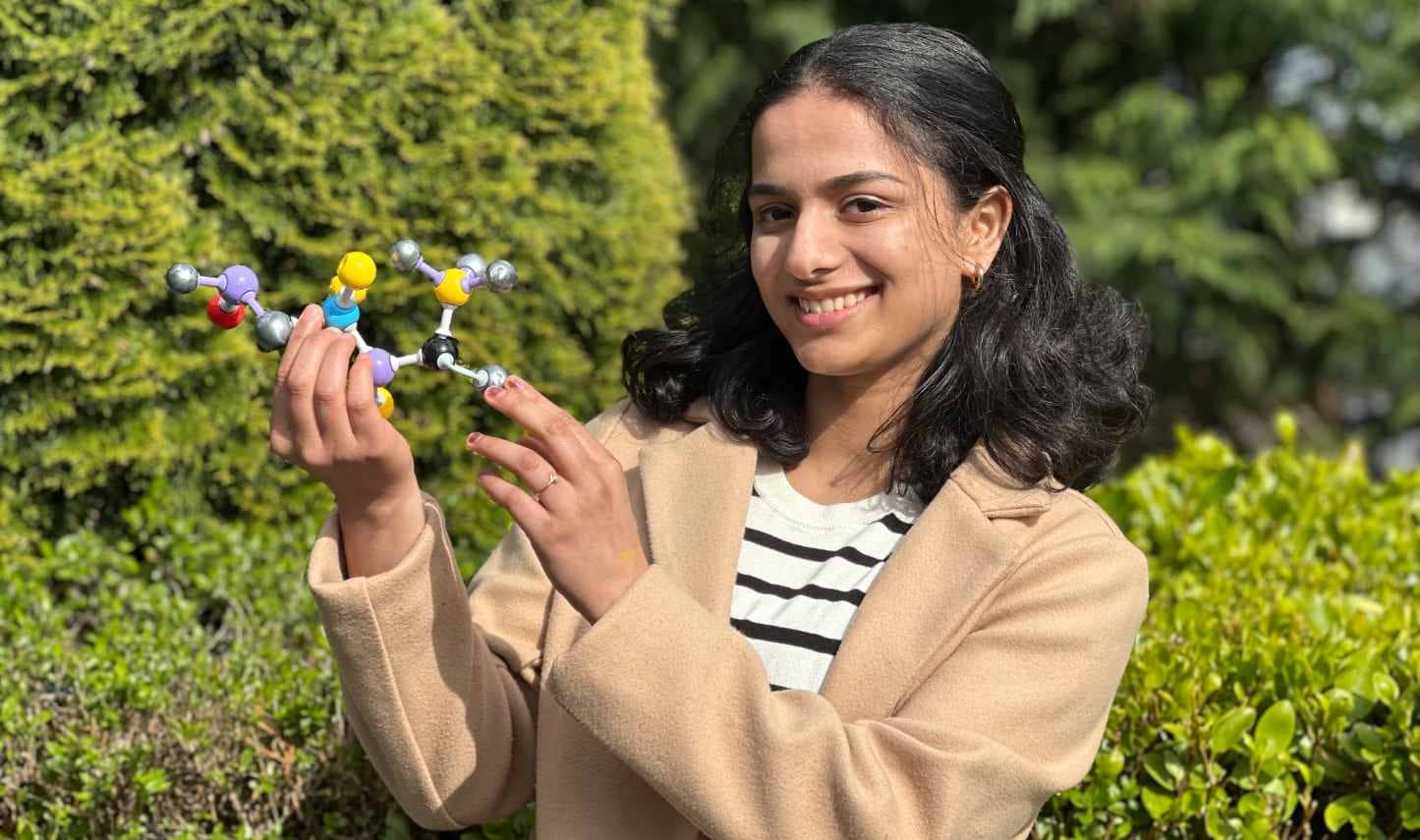
Arya Satheesh, a high schooler from Letterkenny, Ireland, may have just invented such a product, Smithsonian Magazine shared. Satheesh took home the European title at the Earth Prize competition for Eco Purge — a biodegradable plastic she invented that actively degrades microplastics as it breaks down.
View this post on Instagram
Microplastics are tiny, often microscopic, pieces of plastic measuring less than a fifth of an inch. These fragments enter the body, water, and the environment and may be harmful to humans.
“Microplastics can act like toxic sponges in our ecosystems, absorbing heavy metals and synthetic chemicals,” Charles Rolsky, executive director of a Maine-based science nonprofit, told Smithsonian Magazine. He added that when wildlife or humans ingest these particles, “they cause internal inflammation, disrupt digestive systems and can release chemical additives directly into biological tissues.”
With less than ten percent of plastics produced ending up in recycling, microplastic contamination is a growing issue. “I wanted to find a solution,” Satheesh explained. “I thought there’s no point in saying, ‘Oh, recycle, recycle.’”
A Young Innovator
Satheesh became interested in the issue while participating in Ireland’s SciFest STEM fair, ZME Science reported. For SciFest, Satheesh created a smart water monitor that identified contaminants in water. After designing the monitor, Satheesh realized detection wasn’t enough; there needed to be a solution for removing microplastics as well.
Next, Satheesh leveraged ChatGPT to list companies that were working with the enzyme that she wanted to experiment with. Initially, she found the enzyme’s cost prohibitive, but eventually Kevin O’Connor, director of BiOrbic, Ireland’s National Bioeconomy Research Centre, stepped in. He helped her obtain the enzyme, and Satheesh got to work creating a prototype.
She presented an early version of her idea at the Stripe Young Scientist & Technology Exhibition in January. Afterward, she continued to work on and test her invention. In May 2026, she competed in and became the European winner of the Earth Prize, an international environmental competition for 13- to 19-year-olds.
Satheesh explained to Smithsonian Magazine the difference between the two competitions. “The Young Scientist version was primarily a proof of concept,” Satheesh said, whereas the Earth Prize version was more about making a practical and scalable product. “Eco Purge wasn’t just suddenly a huge thing,” she explained. “It evolved step by step.”
Improving Eco Purge
Eco Purge is Satheesh’s name for her biodegradable plastic that eats microplastics. It improves on other plastic alternatives in that it not only breaks down on its own, but as it does, it releases enzymes that decompose nearby PET-derived microplastics. “People have their normal behavior to throw away things, or we can even go dump this in a dump fill, and it still degrades to release that enzyme in the dump fill to degrade the existing microplastic,” Satheesh shared.
Eco Purge still has some hurdles to clear before it is marketable and scalable. For starters, it may work best in closed environments such as compost facilities, as its enzymes are likely to become too diluted in more open environments to degrade microplastics well. Another challenge is the cost. “Standard plastic processing uses high heat that typically destroys biological enzymes that tend to be more delicate,” Rolsky explained. “Scaling enzyme production to a global commercial level could be very costly, making it hard to compete with the low margins of traditional packaging.”
However, Satheesh’s idea is a great starting point for future innovation, said Rolsky, adding, “While bringing any bio-functional material to market takes a ton of work, the ingenuity and ambition shown in this design are inspiring and provide a fantastic foundation for future research.” Satheesh is already improving Eco Purge, and hopes companies can start using it within the next five years.
Eco Purge is an innovative product in that it doesn’t just passively replace non-biodegradable plastics, but it also actively cleans up as it degrades. It’s a reminder that young innovators can come up with creative solutions to some of the world’s biggest challenges.