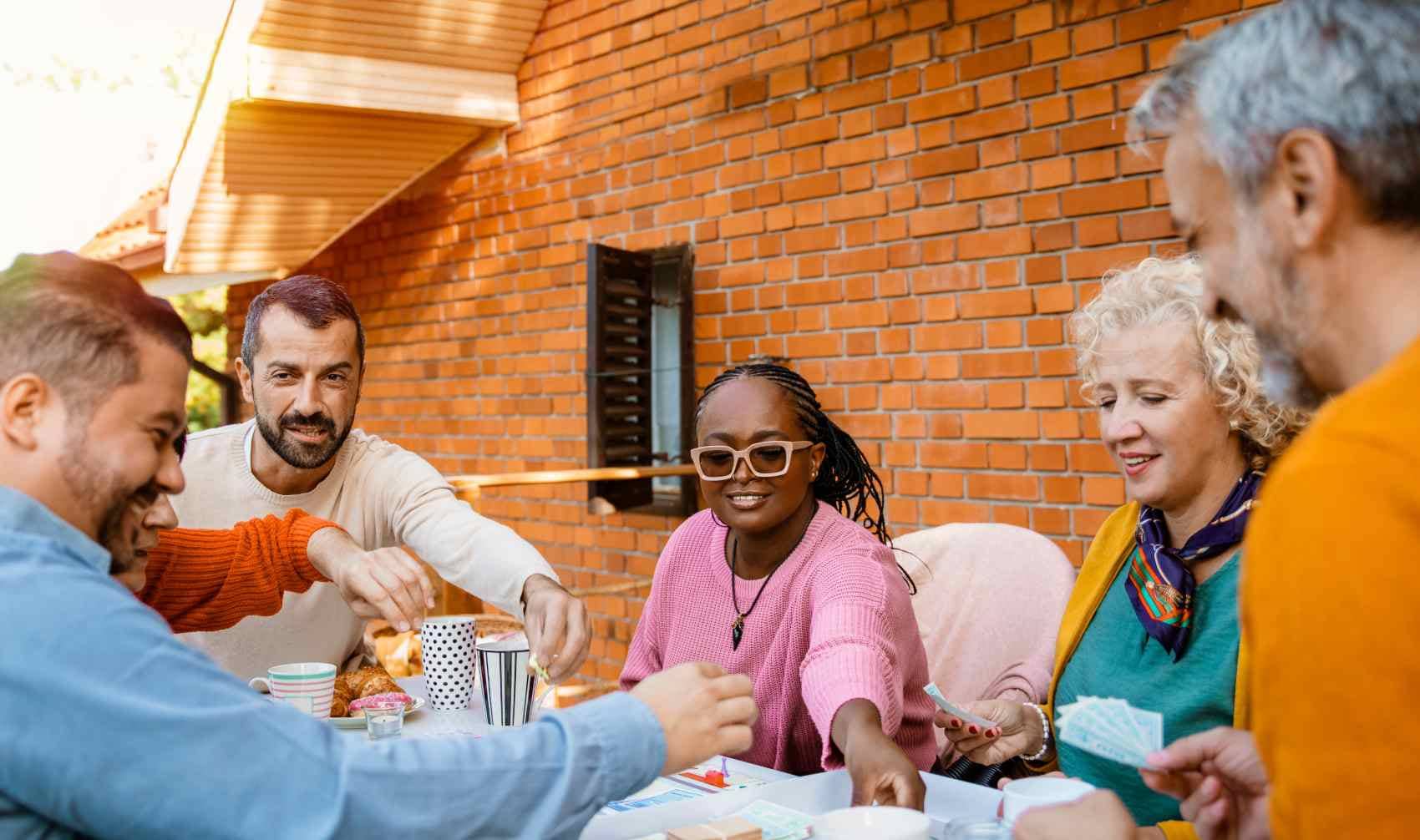
When Adults Embrace Play, They Create Community
A few years ago, Ren Yu was living in New York and, by most measures, doing well. He was productive and physically healthy, while building a life that made sense on paper.
What he was missing was harder to name. It was a lack of connection. So he started something small. A philosophy group. No curriculum, no credentials required. Just people gathering to discuss a single idea at a time.
Within a year, the New York Philosophy Society was drawing well over 100 people on a typical night, sometimes many more. People show up not to perform or network, but to think together. To ask questions about truth, love, purpose, and meaning. “It was only after I started doing it,” Yu says, “seeing not only my own life changing, but also the people around me… that I realized the importance of connection.” What began as a way to fill a gap in his own life became something much larger.
Points of Connection
Across the country, people are creating their own versions of Yu’s gathering. A weekly yoga gathering that grew from 20 people to hundreds showing up in a park. A fitness group where the real friendships form afterward over brunch. A community dinner where strangers end the night sharing stories they didn’t expect to tell.
For many of us, connection used to be built into daily life. School, work, and family created regular opportunities to be around the same people again and again. That structure has weakened. As a result, connection is no longer ambient. It requires intention. People are building what we call communities of play, groups organized around shared activity.
Impact of Connection
To understand its impact, we studied more than 2,000 adults across the United States, comparing those who regularly participate in activity-based communities with those who do not. We then interviewed 20 community builders and surveyed nearly 100 leaders like Yu to understand how these groups actually function.
People who participate in these communities are 28 percentage points more likely to report strong social support and 33 points more likely to report high life satisfaction. They are also more likely to trust others, to form relationships across differences, and to feel a sense of agency in their lives. And yet only about 30 percent of people regularly participate in any kind of shared activity community.
Most people are not opting out because they do not want connection. In our data, people who are not part of these communities are far more likely to say they feel uncomfortable showing up, unsure how to start, or worried they will not fit in. Cost and time play a role, but the biggest barriers are social and psychological. One reason activity-based communities are so effective is that they lower the stakes of showing up. You do not have to arrive ready to connect. You arrive ready to do something. From there, connection can emerge more naturally.
Researchers like Stuart Brown have argued that play is a primary way humans build trust and social bonds. It creates a state of openness and shared attention that makes people more receptive to one another. When people move, create, or learn together, they begin to synchronize, both emotionally and behaviorally. Other researchers have found that shared activities accelerate what might otherwise take much longer to develop. Instead of relying on conversation alone, people build connection through experience.
One community builder describes it simply: The activity gets people in the door, but the real connection happens afterward, when people stay and talk. That pattern shows up again and again: The activity is not the point — it’s the invitation.
Changing Relationships
The impact of these communities is not limited to individual well-being. In our study of community builders, a large majority reported that their groups regularly bring together people across differences in age, race, socioeconomic background, and political identity.
People come because of a shared interest, which creates an immediate sense of familiarity. But because the groups are open and fluid, they also create opportunities to encounter people who are different. One participant described arriving at an event feeling isolated and unsure, only to realize that others felt the same way. There was a whole group of people who felt like that. They felt less alone immediately.
Many of the builders we spoke with did not set out to become leaders. They were trying to solve something in their own lives. They wanted more connection, more meaning, or simply a place where they could belong. In creating that space for others, they often found a deeper sense of purpose themselves. One builder described finding a handwritten note after an event. Someone had written about how much the community meant to them and how lonely they had felt before finding it. Experiences like this can be transformative. They shift how people see their role in the world. Instead of waiting for connection to appear, they begin to see themselves as someone who can create it.
Worth the Effort
At the same time, this work is not effortless. Many builders invest significant time and energy, often without financial support. Some described the tension between wanting to participate as a member and feeling responsible for holding the space for others.
For individuals, the lesson from this research is not that everyone needs to start a community. It is that connection is more accessible than it often feels. The most effective entry point is a shared activity. Something simple, repeatable, and easy to join. A walk in the same place each week. A standing dinner. A regular gathering around a shared interest.
The goal is not to create instant closeness. It is to create a setting where familiarity can grow over time. Seeing the same people again and again, even in low-stakes settings, increases the likelihood of connection. People are creating small, consistent spaces where others can gather. They are building connection through shared experience, not abstract intention. Yu’s philosophy group is one example. It did not start as a solution to a national problem. It started as a response to a personal one.
If you want more connection in your life, the first step may not be to search for it. It may be to create a place where it can happen, and to invite others in.
This article originally appeared on Greater Good, the online magazine of the Greater Good Science Center at UC Berkeley. Click here to read the original article.