Why You Need Rituals in Your Life
By Hope Reese
It’s common to look for new solutions to solve modern-day problems — but what if one of the most powerful tools is also one of humanity’s oldest traditions? In A Time to Gather: How Ritual Created the World — and How It Can Save Us, Bruce Feiler spent three years traveling the world trying to understand the enduring power of rituals and collective gatherings.
Drawing from both ancient traditions and what he calls the new “ritual renaissance,” Feiler explores the many ways people come together to mourn, celebrate, and move into new phases of life. Feiler, who has written about life transitions and the “nonlinear life,” argues that in today’s world, with ever-shifting timelines, we have an even greater need to mark important moments.
Feiler views rituals as essential. “The essence of what people are saying is, ‘I want to take back my humanity,’” says Feiler. Rituals, he argues, can help us do that.
Here is our interview, condensed and edited for clarity.
Hope Reese: When did you realize rituals were so important?
Bruce Feiler: I belong to the tribe of group keepers. I’m the one who leads the family dinner game, organizes the backyard Olympics, leads the family meeting, and gathers the family stories. I think every family, every group, every team, every neighborhood has people who tend to the group.
I wrote books on how to hold your family together and how to make connections across different cultural backgrounds. And what happened was my wife Linda and I went from an empty nest to a full nest in 32 minutes, 21 years ago, when we became the parents of identical twin daughters.
And then, 18 years later, we went from a full nest to an empty nest in 32 minutes when we dropped our children off at opposite ends of the same college campus. I walked into our home here in Brooklyn and I felt homesick in my own home. And I thought “Oh, what I need is a ritual.”
HR: Humans have been conducting rituals for centuries. Why have they endured?
BF: We have 300,000 years of evidence that the earliest thing that humans did was gather to mark moments of pain and confusion. For thousands of centuries and every place we’ve ever looked, we have evidence that in times of change, people turn to the group.
When someone comes into the group, like after a wedding or the birth of a baby. When someone leaves the group, like after a coming of age or a death. When someone moves or changes work, the group holds an occasion to mark this moment. That’s until this century, when we’ve abandoned them.
HR: Tell me more about that — what’s new about our present moment?
BF: Birth rituals are declining. Coming-of-age rituals have plummeted. Yet all around the world, people are creating new ways of gathering. They’re pushing back against digital saturation, loneliness, and division. I went to 16 countries on six continents and joined rituals, and found that everyday people are saying: We’re just not going to surrender to our phones and AI. We’re going to push back and hold humanity together.
HR: Can you share an example of a ritual you can create today? What does it take to work?
BF: I was invited to do a ritual at TED in Vancouver, TED 2026. You need three things to make a ritual work: a beginning, a middle, and an end.
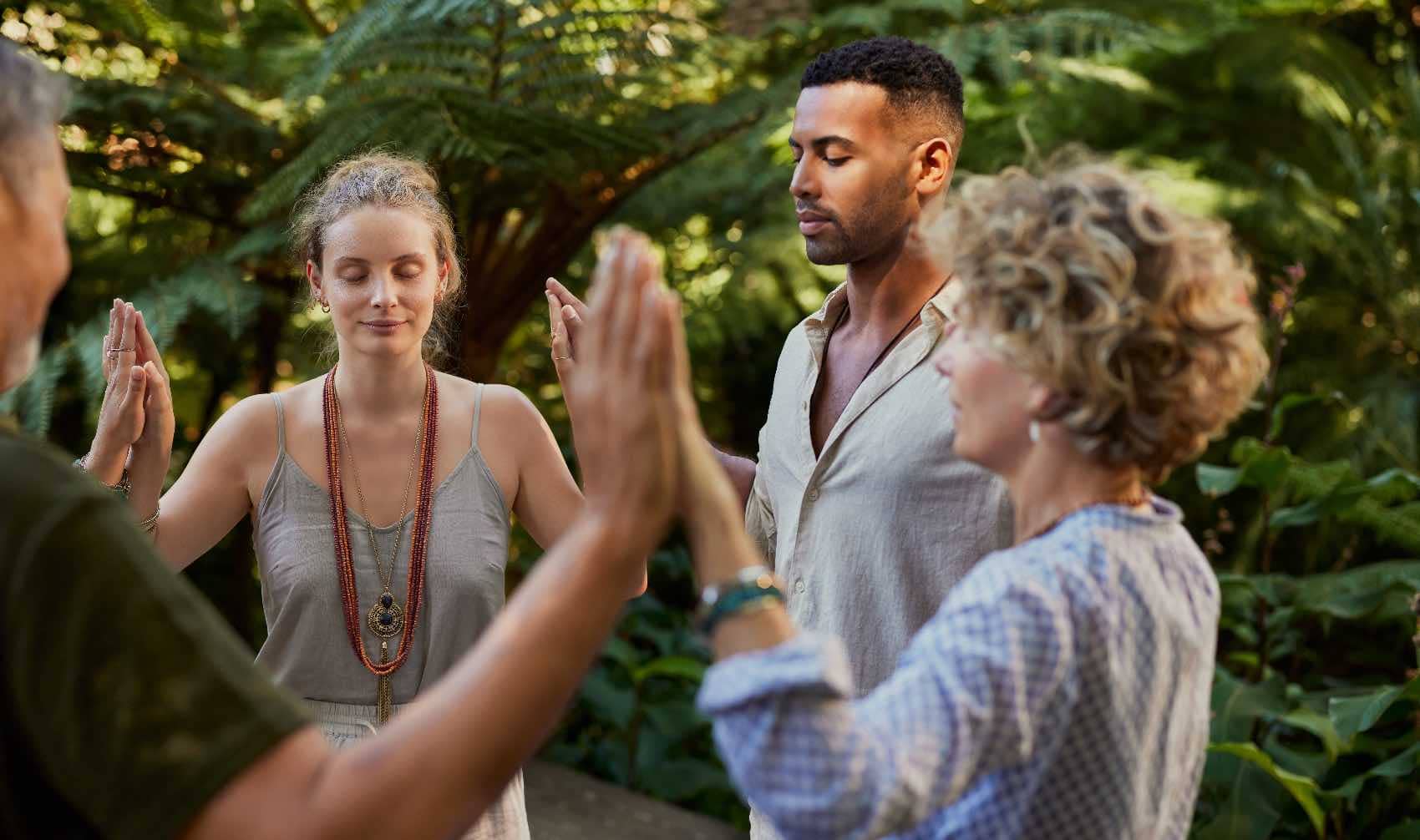
What you need at the beginning is an opening “wow.” Rituals have a sense of specialness, of sacred space. They have boundaries. So you invite people into a circle, a garden, a grove, a place on the beach. You’re saying: Come into this special place. Outside we were that, and inside we are this.
At TED, we had a flameless candle because we were in an institute that didn’t allow flames. Everybody took a flameless candle and answered a simple question: What’s bringing you joy today?
There’s this phrase from the Catholic baptism liturgy that I loved; as you know, I went to a group baptism in the Vatican. So, you want to welcome people with joy. Take a flower, take a candle, sing a song — something that makes people feel welcomed and safe, and now we’re going to go into the ritual.
Then you define the tension and you set the intention. We’re here to send people off to college. We’re here to say goodbye to a colleague. We’re here to mark this retirement. We’re not going to lecture, we’re not going to try to fix it, we’re just going to mark the moment.
For the middle, you need a peace plan. The purpose of the ritual is to kind of resolve a problem.
So what you want in the middle of your ritual is something that makes everybody feel welcome and calms any divisions.
At TED, I divided everybody into groups of two, and I gave each person a piece of bitter chocolate, and they were asked to share what’s challenging in their lives right now with their partner. Then I gave everybody a cube of sweet chocolate, and they were asked to define what would be a sweet outcome for their tension. People shared this outcome with their partner.
Afterward, people took their candles and brought them up to the front of the room where we had bowls of water and they stuck the candle in the water and offered a wish for what they hoped their neighbor’s outcome would be. It’s a small way of saying: OK, we’re all going through difficulty. Let’s do it together.
And when the candles touched the water, they turned on — they were water-activated — and the whole room lit up.
Rituals end with a moment of hope. What is the best version of the group that we can be? We’re going to think back when we danced at the wedding.
So at TED, we took pebbles. People used Sharpies to write out their hope for themselves. Then they took the rock and they put it upside down on a table in the middle of the circle of 50 people. We went person by person, grabbed someone else’s stone, read it out loud, and then carried that home.
What we created in that moment was a kind of web of hope where people are trying to make their own hopes come true and the hopes of someone else.
HR: What are some tools for making a ritual that everyone can get on board with?
BF: It could be a family, an office, a team, a neighborhood. School is a perfect example. If I were to ask you to imagine some of the most fulfilling experiences you had at school, odds are that you would summon the kindergarteners sitting around in a circle in a ritual that welcomes somebody into the classroom, a sports team that sits around in a circle before they go into a competition, a group of theater kids sitting around in a circle before they go on stage.
In a class of kindergarteners, they’re coming in from varied worlds. So what happens when we sit around in a circle is that we create a boundary. We say: Outside we were that, inside we are this. We sit together and we re-welcome one another — we enter this space together.
And so those little rituals do what all rituals do: They calm us, they synchronize our heartbeats, they put us in alignment with the people around us. We have all this knowledge now of mirror neurons and other things, and we know we’re responding to the group. When people first started having ritual gatherings 300,000 years ago, they didn’t have this access to the brain and to biometrics, but they understood it intuitively.
Whatever the situation that you are in, where there are people from different backgrounds, you need some sort of transition element that establishes the group as the mechanism to calm the divisions, make people feel present, and then help them feel aligned.
HR: How are people creating new rituals today?
BF: All around the world, people from boomers to gen z are creating this “ritual renaissance.” They are saying: I crave being around other people. I was raised with a script of top-down, institutionally mandated, prescripted, meaning-free life rituals on a preapproved schedule — that I never approved.
What’s happening is that, from the bottom up, people are creating bespoke, personalized rituals.
What I’m trying to do is invite people to take back their own community and stand up and say, “I can do this right now with my family, with my neighbors, with my colleagues, with my team, with my book group or yoga club,” or whatever it is.
This article originally appeared on Greater Good, the online magazine of the Greater Good Science Center at UC Berkeley. Click here to read the original article.